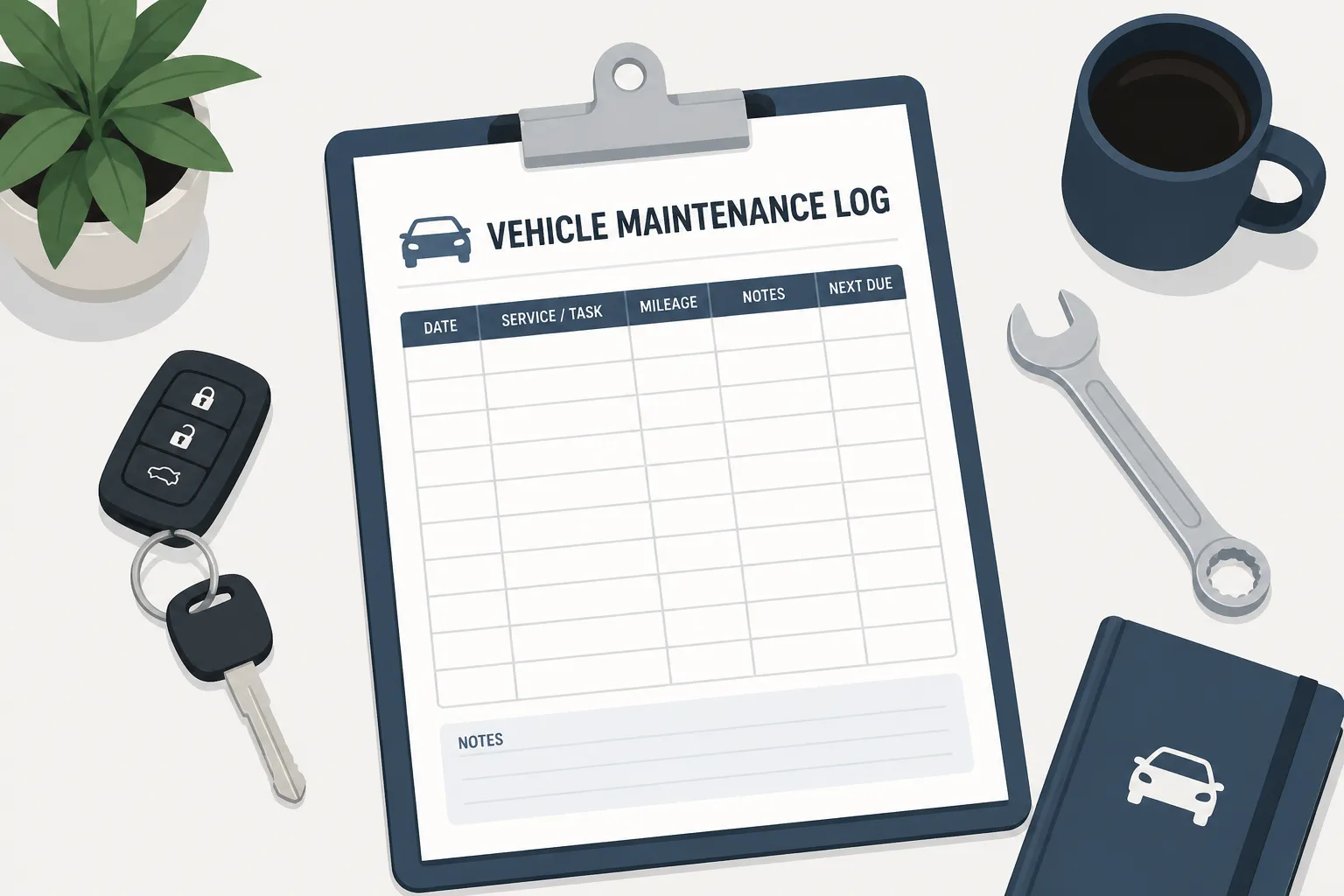
Free Printable Vehicle Maintenance Log: Track Every Service and Save Thousands in Repairs
A check engine light comes on. You call the mechanic and they ask: "When was your last oil change? Have you had the transmission fluid done?" You hesitate. "I think it was... last fall? Or maybe spring?" That hesitation costs you. Without a service history, mechanics recommend everything "just to be safe." With a clear record, they recommend only what you actually need. A printable vehicle maintenance log is the difference between guessing and knowing — and over the life of your car, knowing saves thousands.
This guide covers PrintlyTool's free customizable vehicle maintenance log: what to track, how often to track it, and why a paper log in your glove box beats any app for keeping your car running longer and costing less.
Why a Paper Maintenance Log Beats Apps and Dealership Records
Modern cars have onboard computers. Dealerships keep digital service records. There is an app for everything. So why keep a paper log?
- You own the data: Dealership records are tied to that dealership. Switch mechanics, move to a new city, or buy from a private seller, and those records disappear. A paper log stays with the car regardless of where it gets serviced.
- Resale value, proven: A folder of organized maintenance records increases your car's resale value by hundreds or even thousands of dollars. It tells buyers "this car was cared for." A verbal promise tells them nothing.
- No app can cover everything: That quick oil change at the corner shop? The tire rotation your friend helped with? The wiper blades you replaced in the parking lot? None of those make it into dealership records or apps. Your paper log captures every single service, no matter where or who did it.
- Zero setup, zero learning curve: Open the glove box, grab the log, write down the date and mileage. Done. No pairing a Bluetooth OBD scanner, no creating an account, no navigating app menus while your hands are dirty from checking the oil.
- DIY-friendly: If you do your own oil changes, brake jobs, or filter replacements, a paper log is your only consistent record. Write down the date, mileage, parts used, and any observations — the same data a professional shop would record.
If you manage maintenance across multiple vehicles or even home appliances, our getting started guide covers the full system approach. For pet owners who also need to track health records, see our pet care record guide for similar printable tracking principles.
What Every Vehicle Maintenance Log Should Track
A well-designed maintenance log captures not just what was done, but the context that matters for future decisions:
Essential Fields
- Date of service: When the work was performed. This matters alongside mileage — some fluids degrade with time as much as with distance.
- Mileage at service: The odometer reading. Mileage intervals are the primary trigger for most maintenance items, and tracking actual vs. recommended mileage reveals whether you are ahead of or behind on your schedule.
- Service performed: Be specific. "Oil change" is fine. "Oil change — Mobil 1 5W-30 full synthetic, filter part #M1-110A" is better. When you need to buy the same filter next time, the part number is right there.
- Parts replaced: Part names, brands, and part numbers. Essential for warranty claims and for DIYers who need to reorder the same components.
- Cost: Parts, labor, tax, total. This builds a realistic picture of your car's running costs over time. Most people underestimate by 30-40% because they forget about tires, brakes, and other irregular expenses.
- Service provider: Shop name or "DIY." If a shop did the work, note the location and contact info. If a warranty issue arises, you know exactly who to call.
Next-Service Reminders
The most useful maintenance logs include a "next service due" section — both the date and the mileage. When you open the log to record today's oil change, you also write down: "Next oil change at 65,000 miles or November 2026." Six months later, when you glance at the log to check when the next service is due, the answer is already there.
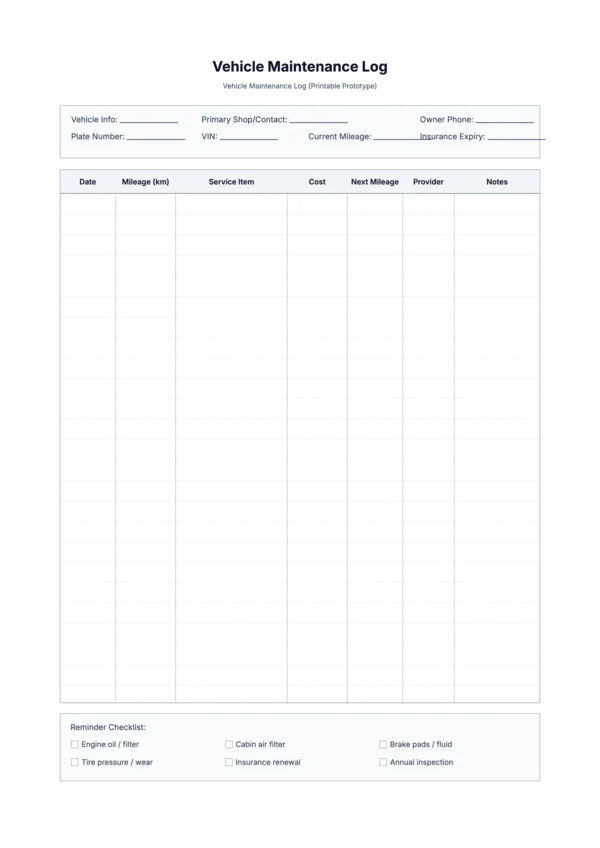
Download a free printable vehicle maintenance log to track mileage, service history, costs, and next due intervals on one A4/Letter page.
PrintlyTool's vehicle maintenance log template lets you customize the service categories and layout. Different cars need different tracking: a Toyota Corolla needs basic items tracked (oil, tires, brakes, filters), while a Porsche 911 or a modified off-road vehicle may need additional categories for transmission fluid, differential oil, suspension components, or aftermarket part records.
The Maintenance Schedule Most People Overlook
Your owner's manual contains a maintenance schedule. But most people stop reading after the oil change interval. Here is what else belongs in your log, organized by interval:
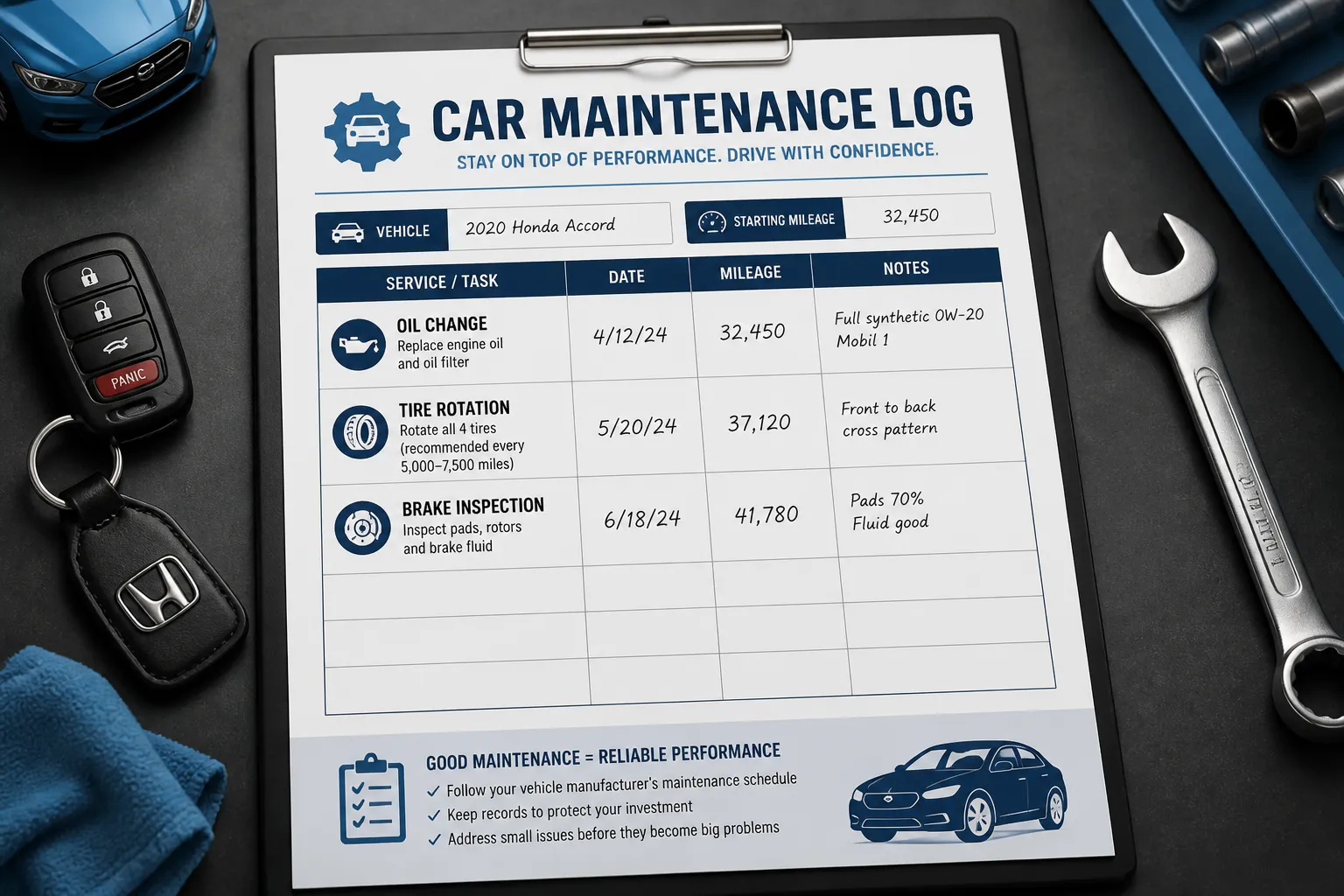
Every 3,000-7,500 Miles (or 3-6 Months)
- Oil and filter change: The single most important maintenance item. Check your manual for the recommended interval — modern synthetic oils often allow 7,500+ miles, but severe driving conditions (short trips, stop-and-go traffic, extreme temperatures) shorten the interval.
- Tire pressure check and rotation: Rotating tires every oil change extends tire life by 20-30%. Log which position each tire moved to.
- Fluid level check: Coolant, brake fluid, power steering fluid, windshield washer fluid. Top off as needed and note any that were unusually low — that may indicate a leak.
Every 15,000-30,000 Miles (or Annually)
- Engine air filter: A clogged air filter reduces fuel economy and performance. Inspect at every oil change; replace annually or as needed.
- Cabin air filter: Often forgotten. A dirty cabin filter reduces HVAC efficiency and can cause musty odors. Easy DIY replacement on most cars.
- Brake inspection: Measure pad thickness, check rotor condition, inspect brake lines. Brake wear is highly individual — aggressive drivers and city drivers wear pads faster. Your log tells you your actual replacement interval.
- Battery test: Especially important before winter. Most auto parts stores test batteries for free. Log the voltage and cold cranking amps reading.
Every 30,000-60,000 Miles
- Transmission fluid: Often called "lifetime fluid" by manufacturers — but "lifetime" usually means the warranty period, not your actual ownership. Many independent mechanics recommend changes at 50,000-60,000 miles, especially for automatic transmissions.
- Spark plugs: Worn spark plugs cause misfires, rough idling, and reduced fuel economy. Copper plugs need replacement around 30,000 miles; iridium and platinum plugs can go 60,000-100,000.
- Coolant flush: Coolant degrades over time, losing its anti-corrosion properties. Old coolant can cause radiator, water pump, and head gasket damage — expensive repairs that a $100 flush prevents.
- Serpentine belt: Inspect for cracks and wear. A snapped belt leaves you stranded. Most belts last 50,000-80,000 miles.
Every 60,000-100,000 Miles
- Timing belt (if equipped): This is the big one. A snapped timing belt can destroy an interference engine entirely. Replacement interval varies by make and model — check your manual. The cost ($500-$1,200) is intimidating, but an engine replacement ($3,000-$8,000) is far worse.
- Water pump: Often replaced at the same time as the timing belt since the labor overlaps. If your water pump is driven by the timing belt, always replace both together.
- Shocks and struts: Worn suspension reduces handling, braking performance, and tire life. If your car bounces more than once after hitting a bump, the shocks are due.
How a Maintenance Log Saves You Money
The math is straightforward. Let's take a typical car owned for 10 years:
| Scenario | Outcome | Approximate Cost |
|---|---|---|
| Follow scheduled maintenance, logged | Car runs reliably for 150,000+ miles. Major issues caught early. | Routine maintenance costs spread predictably over time. |
| Skip or forget maintenance, unlogged | Engine sludge from skipped oil changes. Transmission failure at 100,000 miles. Brake rotors warped from pads worn to metal. | $3,000-$8,000+ in avoidable repairs. |
| Maintain but no records | Car runs well, but at resale, buyer has no evidence. You get the "no service history" price — typically $1,000-$2,500 less than the same car with records. | Lost resale value. |
A maintenance log costs nothing and takes 30 seconds per entry. Over a decade of ownership, those 30-second entries can be worth thousands.
For Vehicle Handovers and Inspections
When you are selling a car, buying a used car, or handing a vehicle between drivers, a structured inspection log is essential. PrintlyTool's vehicle handover inspection template covers:
- Vehicle identification and mileage at handover
- Exterior condition check (body panels, lights, glass, mirrors, tires)
- Interior condition check (seats, dashboard, controls, odors, warning lights)
- Mechanical check (engine start, brakes, steering, transmission, suspension noise)
- Documentation check (registration, insurance, service history)
- Both-party signature sections for accountability
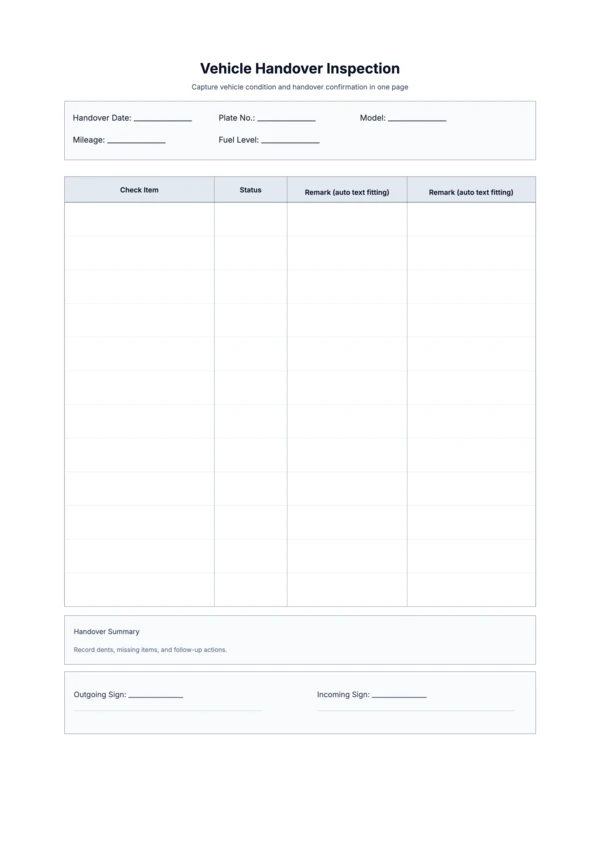
Use this free vehicle handover inspection template to log handover date, vehicle info, checklist status, remarks, and signatures.
Use this alongside your maintenance log when buying or selling. A complete set of service records plus a clean handover inspection report tells a buyer everything they need to know — and justifies your asking price.
How PrintlyTool's Vehicle Maintenance Log Is Different
Most printable vehicle logs are generic spreadsheets — one fixed layout for all cars. PrintlyTool's approach recognizes that different vehicles and drivers need different tracking:
- Customize service categories: Add or remove rows based on your car's actual maintenance needs. A hybrid needs battery health tracking. A diesel needs DPF regeneration logs. A classic car needs rust treatment and storage prep records.
- Adjust for multiple vehicles: Print separate logs for each car in your household, color-coded or labeled by vehicle
- Mileage or date-based tracking: Choose the format that matches how you think about maintenance
- Clean, garage-ready design: Printable on standard paper, large enough to write in with gloves on, and organized so you can find the last oil change entry in three seconds
- No registration: Download the PDF and print. No email, no account, no spam
Keep your maintenance log and handover inspection sheet together in the glove box — a complete vehicle history that travels with the car.
FAQ: Vehicle Maintenance Logs
How often should I log vehicle maintenance?
Log every service event, no matter how minor. Oil changes, tire rotations, wiper blade replacements, bulb changes, fluid top-offs — every entry builds the record. The 30 seconds it takes to write an entry is trivial compared to the value of a complete history.
What if I bought a used car with no maintenance records?
Start a fresh log from your ownership date. Note the mileage at purchase and any known service history (even if it is verbal — mark it as "per previous owner"). Going forward, log everything. Within a year or two, you will have built a solid record for the next owner or for your own reference.
Can I use the same log for a motorcycle or RV?
Yes. The template fields are universal — mileage (or engine hours for boats and some RVs), date, service type, parts, and cost. You may want to customize the service categories: a motorcycle needs chain maintenance and fork oil changes tracked, while an RV needs generator service and roof seal inspections.
Should I keep receipts with my maintenance log?
Yes. Staple or paperclip receipts to the corresponding log page, or keep them in a folder organized by date. Receipts provide proof of parts used and service performed, which is especially important for warranty claims and for buyers who want to verify the maintenance history.
How long should I keep maintenance records?
Keep records for as long as you own the vehicle, plus transfer them to the next owner when you sell. If you want to reference historical data after selling, make copies for yourself before transferring the originals. A complete service history is a selling feature — include it in the sale.
What is the most commonly overlooked maintenance item?
Cabin air filters and brake fluid flushes. Cabin filters are out of sight and easy to forget, but a dirty one reduces airflow and can introduce mold spores into the cabin. Brake fluid absorbs moisture over time, which lowers its boiling point and reduces braking performance — most manufacturers recommend flushing every 2-3 years regardless of mileage.
Can PrintlyTool's log be used for fleet vehicles?
Yes, but for fleet management with multiple vehicles and drivers, a digital spreadsheet or fleet management software may be more practical for aggregating data across vehicles. PrintlyTool's printable log is best for personal vehicles, family cars, and small business owners managing 1-5 vehicles.
Start Tracking Today
Your car is likely the second most expensive thing you own. A maintenance log costs nothing, takes 30 seconds per entry, and pays for itself many times over — in avoided repairs, better resale value, and the peace of mind that comes from knowing exactly when every service was done.
Print your vehicle maintenance log, drop it in the glove box, and start writing down every service from today forward. Your future self — and your car's next owner — will thank you.