Pet Care Record Guide: Free Printable Medication Log & Pet Sitter Information Sheet for Worry-Free Travel
Leaving your pet behind when you travel is stressful enough. What makes it worse: worrying whether the sitter remembered the medication schedule, fed the right amount, or knows which vet to call in an emergency.
Relying on verbal instructions is a gamble. A sticky note can fall off the fridge. A text message can get buried in a chat thread. A clear, printed pet care sheet posted where everyone can see it is the closest thing to peace of mind while you're away.
This guide covers PrintlyTool's two free printable pet care templates: the Pet Medication Log and the Pet Sitter Information Sheet. Customize colors and layouts online, export as PDF, and print — giving your sitter everything they need to care for your furry friend properly.
Why Paper Records Beat Apps for Pet Sitting Handoffs
There are dozens of pet health apps on the market. But when you're handing your pet over to a sitter — whether it's a professional service, a neighbor, or your in-laws — paper has clear advantages:
- Zero learning curve: A printed sheet taped to the fridge requires no app download, no account creation, no tutorial. Anyone can read it instantly.
- Impossible to miss: Phone notifications can be swiped away. A bright sheet of paper next to the food bowl cannot. The physical presence is the reminder.
- Emergency-ready: If your pet needs urgent vet care while you're unreachable, the sitter hands the sheet to the vet. Allergies, current medications, dosing history — no guessing, no waiting for your callback.
- Accountability built in: Every dose gets a checkmark. When you come home, one glance at the log tells you whether medications were given on schedule. No need to cross-reference timestamps in a chat app.
You don't have to choose between digital and paper. Use an app for long-term health tracking at home. Print a medication log and information sheet for sitter handoffs. Together, they're a complete care system. If you're also managing health records for elderly family members, check out our family health tracking templates guide.
Pet Medication Log — Never Miss a Dose Again
For pets on long-term medications — senior dogs with arthritis, cats with hyperthyroidism, dogs with heart conditions — missing a dose can have real consequences. Doubling up because someone forgot whether the morning dose was given is equally dangerous.
When You Need a Medication Log
- Your pet has a chronic condition requiring daily medication (arthritis, heart disease, kidney disease, thyroid issues, diabetes)
- Your pet is on a short-term treatment plan (post-surgery antibiotics, skin medication, ear drops) that must be followed precisely for 7-14 days
- You have multiple pets with different medication schedules that are easy to mix up
- Someone else — a sitter, a family member, a dog walker — will be administering medications while you're away
What a Good Medication Log Tracks
A useful medication log covers these dimensions:
- Medication name: Use the full name your vet uses, not shorthand. "Vetmedin 5mg" is clearer than "heart pill"
- Dosage: Exact amount per administration — "1/2 tablet," "2.5ml liquid," "1 capsule." Never write "as directed"
- Frequency: How many times per day and when — "twice daily with food," "once at bedtime," "every 12 hours"
- Administration method: Oral, topical, eye drops, ear drops, subcutaneous injection — the sitter needs to know how to give it
- Dose confirmation: A checkbox for each administration. This is the single most important feature — it prevents both missed and double doses
- Notes: Space for side effects or observations ("vomited 30 min after dose," "refused to eat with pill"). This is gold for your vet at the next appointment
PrintlyTool's Pet Medication Log Design
Our Pet Medication Log is built for real-world multi-pet, multi-medication complexity:
- Supports separate sheets per pet — print a different color for each animal
- Medication columns × date rows — one sheet covers an entire month
- Multiple checkboxes per day for multi-dose schedules (morning, noon, evening, bedtime)
- Notes column for side effects, missed doses, or special observations
- Summary area at the bottom for vet contact info and next appointment date

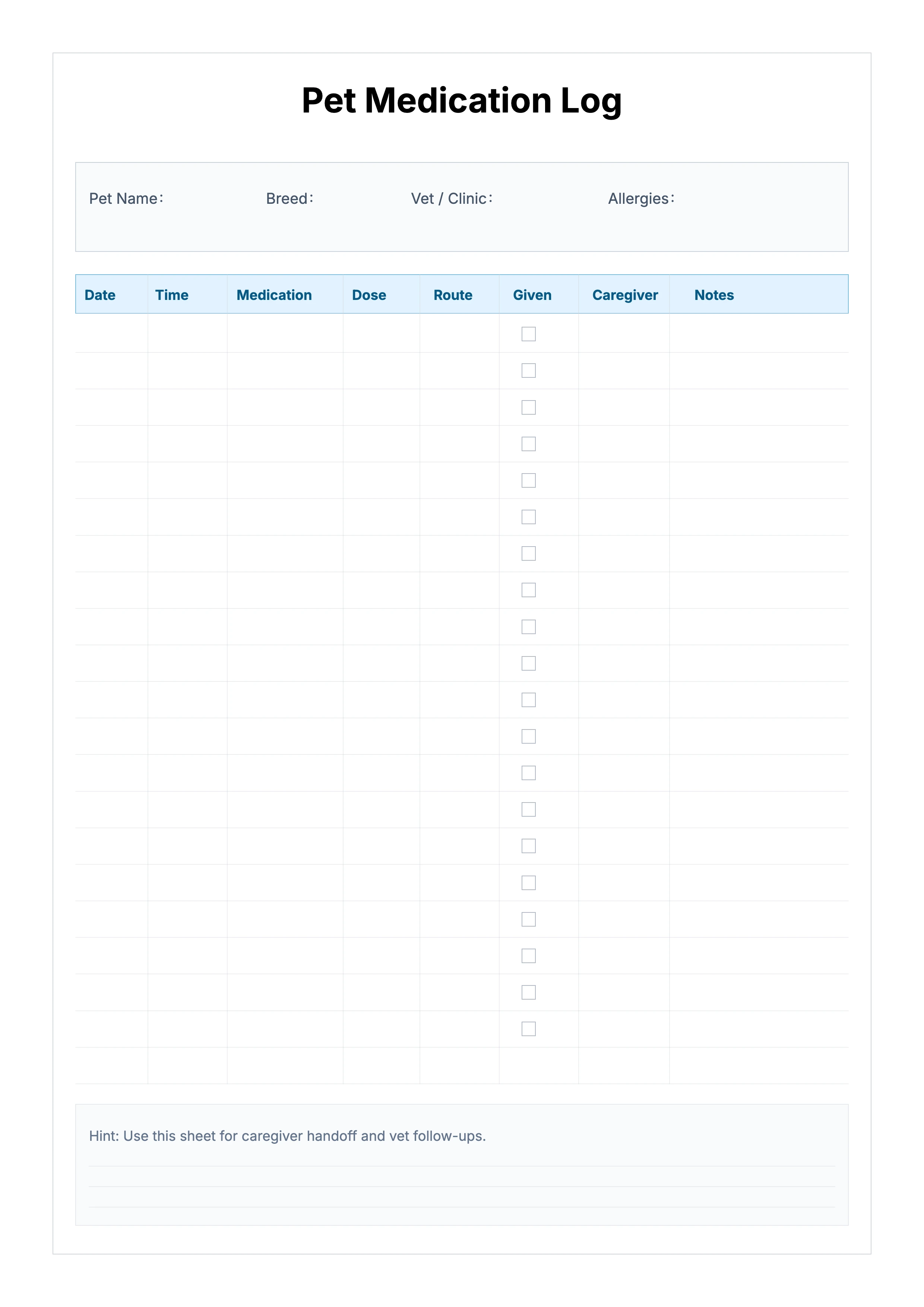
Free printable pet medication log with date, time, medication, dose, route, given status, and caregiver fields.
Post this sheet next to your pet's food station. Check off each dose immediately after giving it — by the end of the day, there's zero ambiguity about what was given and when.
Pet Sitter Information Sheet — The Ultimate Handoff Document
If the medication log is the daily checklist, the information sheet is the owner's manual for your pet. Every sitter needs one.
What Every Sitter Information Sheet Must Include
Picture your sitter walking in for the first time. They don't know where you keep the food. They don't know your dog is terrified of thunderstorms. They don't know that your cat needs the litter box scooped twice a day or she'll find alternative arrangements. A complete information sheet covers:
- Pet basics: Name, breed, age, weight, spay/neuter status, microchip number
- Feeding instructions: What food, how much per meal, how many meals per day, and any food allergies or forbidden items (chocolate, grapes, xylitol — list them explicitly)
- Medication summary: Brief overview of what medications are needed, with a reference to the full medication log for detailed tracking
- Daily routine & behavior notes: How many walks per day, favorite toys, fears and triggers (thunderstorms, fireworks, vacuum cleaners, other dogs), commands they respond to
- Emergency contacts: Your phone number, a backup contact who has a key, and your preferred veterinary clinic with address and phone
- Vet information: Your primary veterinarian's name and clinic number, any known drug allergies, and your preferences for emergency care decisions
PrintlyTool's Pet Sitter Information Sheet Design
The Pet Sitter Information Sheet packs all critical information onto a single A4 page with a clean, fill-in-the-blanks layout:
- Top section: Pet identification — name, breed, age, weight, distinguishing features
- Feeding & medication section: Clear tables for meal schedule and medication instructions
- Activity & behavior section: Walks, play preferences, fears, and house rules
- Emergency section: Your contact, backup contact, preferred vet, and nearest 24-hour emergency clinic
- Free-form notes area: "Likes to sleep under the couch," "Will beg for treats but don't give in," "Open a window in the morning"
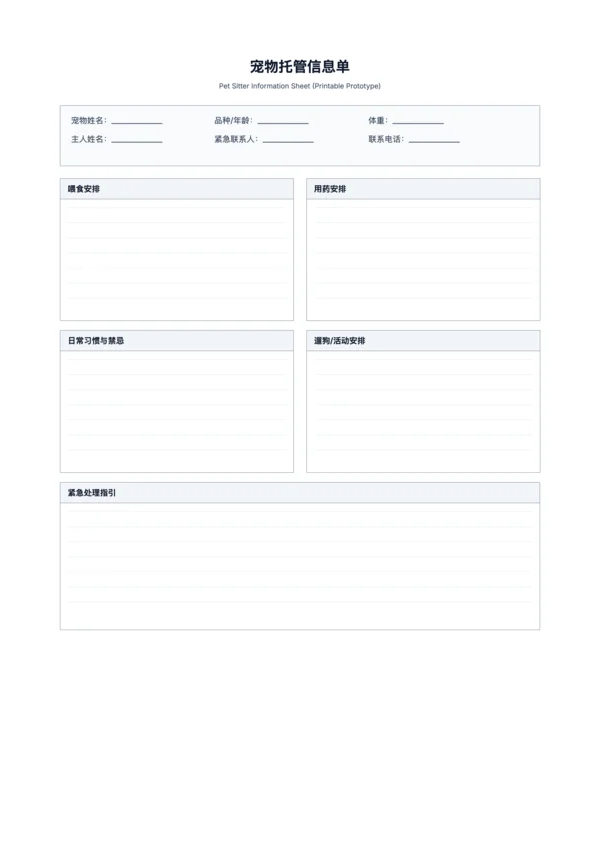
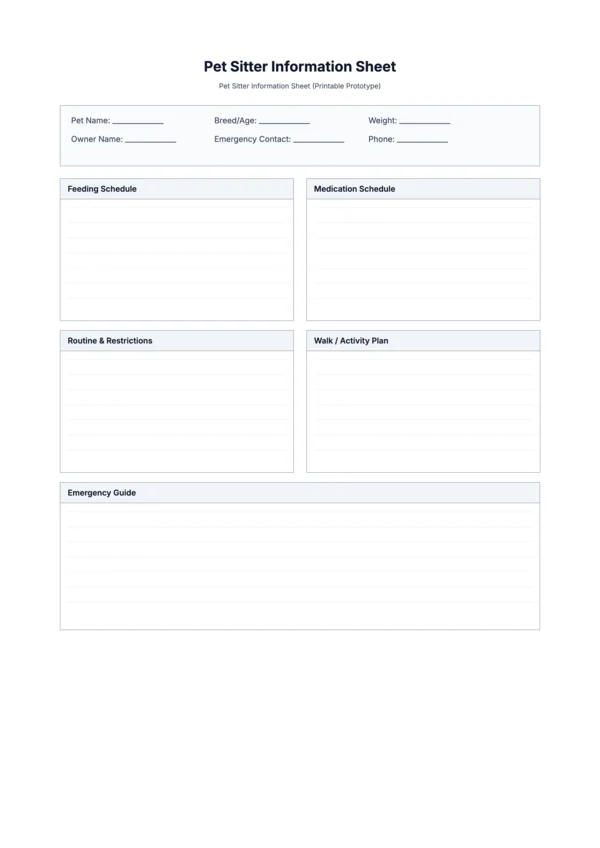
Download a free printable pet sitter information sheet with feeding, medication, routine notes, and emergency contacts on one A4/Letter page.
Print this sheet before every trip, fill it out completely, and post it on the fridge alongside the medication log. Your sitter will thank you — and more importantly, your pet will be safer for it.
How to Build a Complete Pet Care Handoff System
The two templates work together to create a foolproof handoff:
Scenario 1: Short Trip (1-3 Days)
For a weekend away with a cat who stays home:
- Post the Pet Sitter Information Sheet on the fridge — it tells the neighbor exactly how much to feed and when to scoop the litter
- Write your return date clearly on the sheet so the sitter knows how long they're covering
- If your cat isn't on any medications, skip the medication log
Scenario 2: Extended Trip (1 Week or More)
For a longer trip where a professional sitter or boarding facility takes over:
- Information sheet is mandatory — treat it as your pet's handoff file. Print it, fill it out completely, hand it over with the keys
- Medication log is mandatory — print a fresh monthly sheet and walk the sitter through the first dose, showing them how to check off each administration
- Add a "days until I return" count on the sheet so the sitter knows the timeline
- Write in the notes: "Contact me immediately if: vomiting more than 2 times, diarrhea lasting over 24 hours, refusing food for more than 1 day, or anything that doesn't feel right"
Scenario 3: Multi-Pet Household
If you have a dog, a cat, and a rabbit:
- Separate information sheet per species — their feeding, medication, and behavior needs are completely different
- Separate medication log per pet if they each have medications. Print on different colored paper (blue for the dog, pink for the cat, yellow for the rabbit)
- Write each pet's name prominently at the top — this prevents mix-ups when the sitter is tired or in a hurry
- Note feeding order if it matters — if your dog and cat can't eat side by side without conflict, write "feed the dog first in the kitchen, then the cat in the laundry room"
For multi-pet households tracking expenses, you might also find our small business and office templates useful for organizing pet-related paperwork and budgets. And if you're caring for human family members rather than furry ones, the same "medication log + handover sheet" approach applies — see our caregiver daily record guide for the human caregiving version.
FAQ
Can the medication log track supplements and preventatives?
Absolutely. In addition to prescription medications, you can use the log to track joint supplements (glucosamine, fish oil), monthly flea and tick preventatives, heartworm medication, and probiotics. Clearly label these as "supplement" or "preventative" in the medication name column so the sitter understands which items are medically critical and which are wellness additions.
Should I list my pet's bad habits on the sitter sheet?
Yes, and be brutally honest. "Barks at other dogs on walks," "Will counter-surf if you turn your back," "Chews on charging cables," "Terrified of children." The sitter needs to know this to prevent problems, not be surprised by them. Withholding behavioral information doesn't make your pet look better — it sets the sitter up for failure and your pet up for stress. Transparency protects everyone.
What if the sitter refuses to fill out the medication log?
Some sitters or friends helping out might find a checklist "too much paperwork." Solutions:
- Lower the barrier: Pre-fill the medication names, doses, and times yourself. All they need to do is put a checkmark in a box
- Explain the stakes: "This is a twice-daily heart medication. Missing a dose can be serious." Understanding the why makes the what feel less arbitrary
- Positive reinforcement: If they fill out the log faithfully, tip extra or bring back a souvenir. A little appreciation goes further than a lot of nagging
How long should I keep completed medication logs?
Keep them for at least a year, especially for pets with chronic conditions. Bring them to vet appointments — a month of detailed logs tells your vet more about medication efficacy and side effects than a 15-minute consult ever could. If your pet has an adverse reaction or a change in condition, the log is a timeline of exactly what was given and when, which is invaluable for diagnosis.
Can I take photos of the sheets as a backup?
Strongly recommended. Before you leave, photograph both the completed information sheet and the blank medication log. Send them to yourself on a messaging app. While you're away, ask your sitter to send a daily photo of that day's medication log row — you get remote confirmation that doses were given, and you have a digital backup if the physical sheet gets lost or damaged.
Conclusion
Being a responsible pet owner isn't about buying the most expensive food or the fanciest gadgets. It's about doing the unglamorous preparation work — making sure that when someone else steps into your shoes, they have everything they need to keep your pet safe, healthy, and happy.
A medication log ensures every dose is given and tracked. A sitter information sheet ensures every instruction is written down, not forgotten. Together, they're your pet's safety net while you're away.
Create your pet's care file today with PrintlyTool's free templates. Customize online, export as PDF, and print: Pet Medication Log for foolproof medication tracking, and Pet Sitter Information Sheet for a complete sitter handoff document.
For more health tracking tools, see our family health tracking templates guide — because caring for the whole family includes the furry members too.