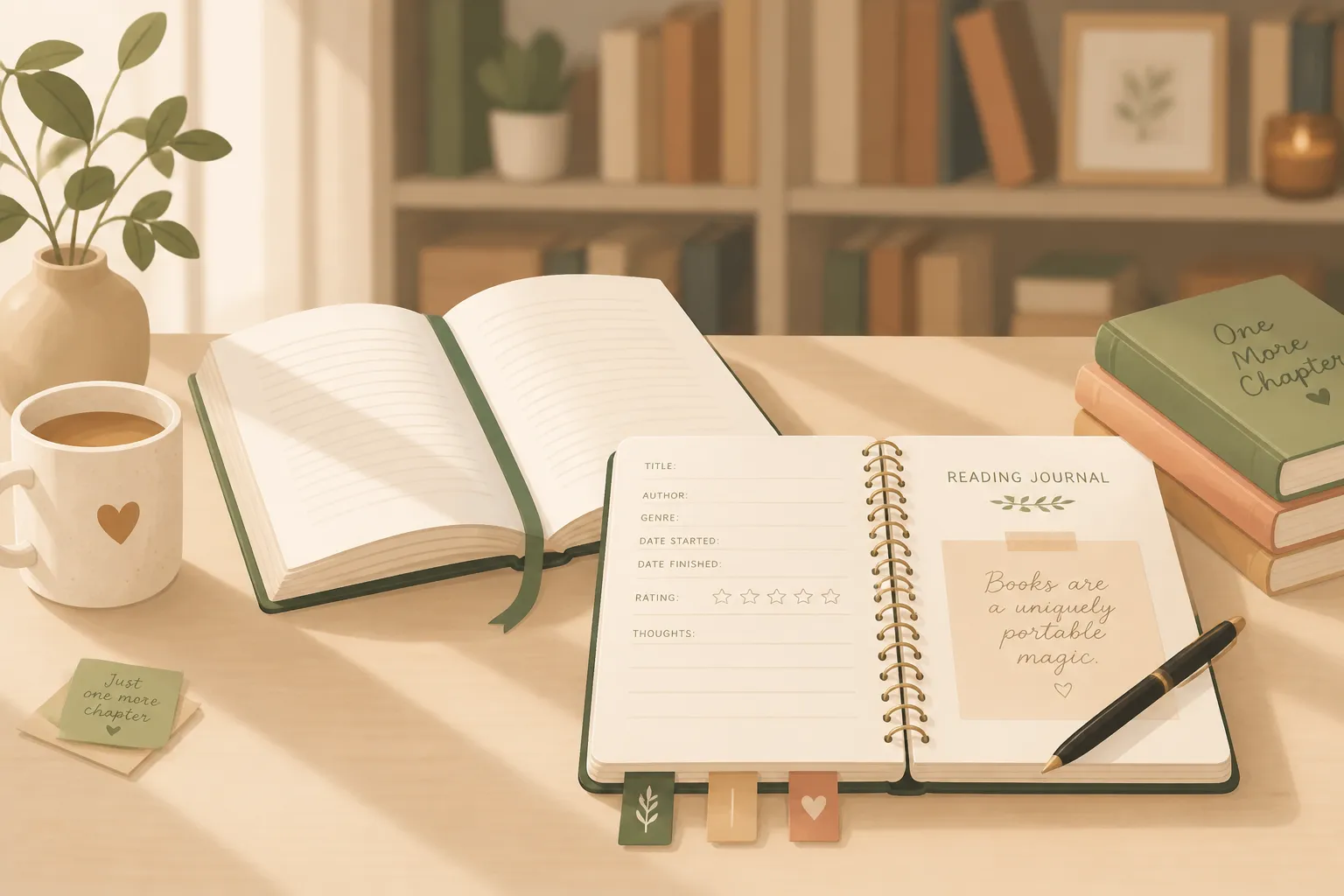
Free Printable Reading Journal: Track Every Book, Remember What You Read
You finish a book. You loved it. Six months later, a friend asks what you thought of it, and you can barely remember the main character's name — let alone why it mattered to you. This happens to everyone. We read dozens of books a year, but without a system to capture what we learned and felt, most of it fades. A printable reading journal changes that. It turns passive consumption into active engagement, and it gives you a personal library of your own thoughts to revisit anytime.
This guide shows you how PrintlyTool's free customizable reading journal works, what to track in your book log, and how a simple paper system can deepen your reading life far more than any app.
Why a Paper Reading Journal Beats Digital Tracking
Goodreads and StoryGraph are popular for a reason — they make it easy to log titles and see what friends are reading. But they also have limitations that a paper journal neatly solves:
- You write what you actually think, not what looks good publicly: On social reading platforms, every review is semi-public. That subtly changes what you write. A paper journal is private — you can be honest about why a book disappointed you without worrying about the author's feelings or your friends' opinions.
- No algorithm deciding what you read next: Goodreads recommendations are driven by an algorithm optimized for engagement, not for your growth as a reader. A paper journal with a "to-read" section lets you curate your own list based on your actual curiosity.
- Handwriting deepens memory: Studies consistently show that writing by hand engages different cognitive processes than typing. When you write a book review by hand, you remember the book better — not just the facts, but how it made you feel.
- It becomes a physical artifact: A filled reading journal is a personal history of your reading life. Five years from now, flipping through it will bring back not just the books, but who you were when you read them.
- No screen before bed: Many people read before sleep. Logging a book in a paper journal keeps you off screens during the wind-down period, supporting better sleep hygiene.
What to Track in Your Reading Journal
A well-designed reading journal captures both the facts and the feelings. PrintlyTool's reading journal template includes these sections:
Book Information (The Facts)
- Title and author: The basics. Include the translator's name for translated works — it matters more than most readers realize.
- Genre and format: Fiction/nonfiction, and whether you read it in print, on an e-reader, or listened to the audiobook. Tracking format reveals preferences you might not consciously notice.
- Date started and finished: Seeing your reading pace over time helps you set realistic goals. Some months you devour four books; other months you slowly savor one. Both are valid.
- Page count: Useful for year-end summaries — "I read 12,400 pages this year" feels different from "I read 35 books," especially when book lengths vary from novellas to doorstoppers.
Your Response (The Feelings)
- Rating: PrintlyTool's template supports customizable rating scales. Use stars, numbers, or a simple "loved / liked / okay / not for me" system. The scale matters less than consistency.
- Favorite quotes: Copy down passages that struck you. A year later, rereading your collected quotes is like a highlight reel of your reading year.
- Key themes and ideas: What was this book really about, beneath the plot? A novel about a family road trip might really be about grief. A business book about leadership might really be about self-awareness.
- Personal response: The most important section. How did this book change your thinking? What will you do differently because you read it? Did it challenge a belief, introduce a new idea, or simply bring you joy?
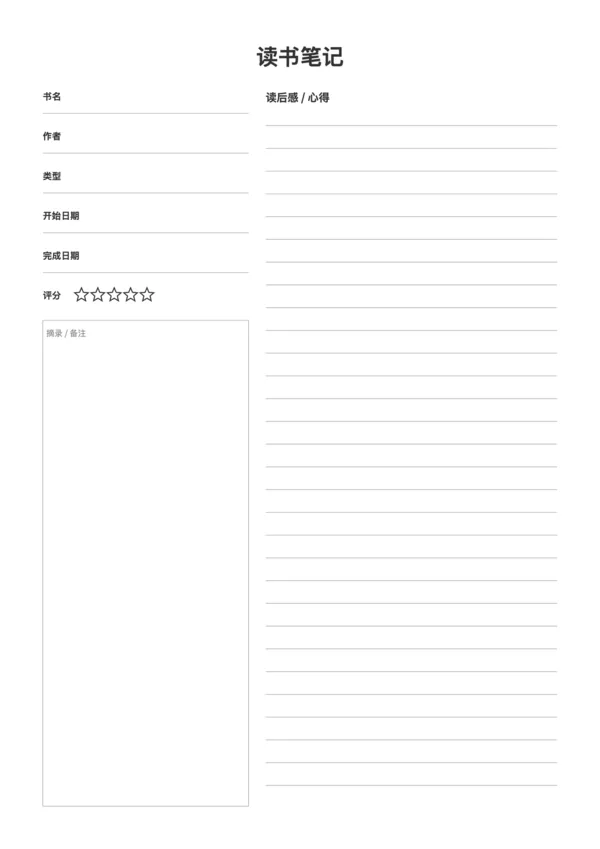
Professional reading journal template featuring book details, rating system, notes area, and reflection space. Perfect for students and book lovers to organize reading insights.
The Reading Log: Track Every Book at a Glance
Alongside a detailed journal for individual books, a reading log serves a different purpose: it is a running list of everything you have read, one line per book. Think of the journal as the deep dive and the log as the dashboard.
Why You Need Both
The journal captures richness. The log captures completeness. Together, they give you:
- A monthly and yearly overview of your reading volume
- Quick reference when someone asks "what have you read lately?"
- Motivation through visible accumulation — seeing 47 entries on your reading log by October is deeply satisfying
- A tool for identifying patterns: are you reading mostly one genre? Mostly male or female authors? Mostly books published in the last two years? The log surface patterns you might not notice day to day.
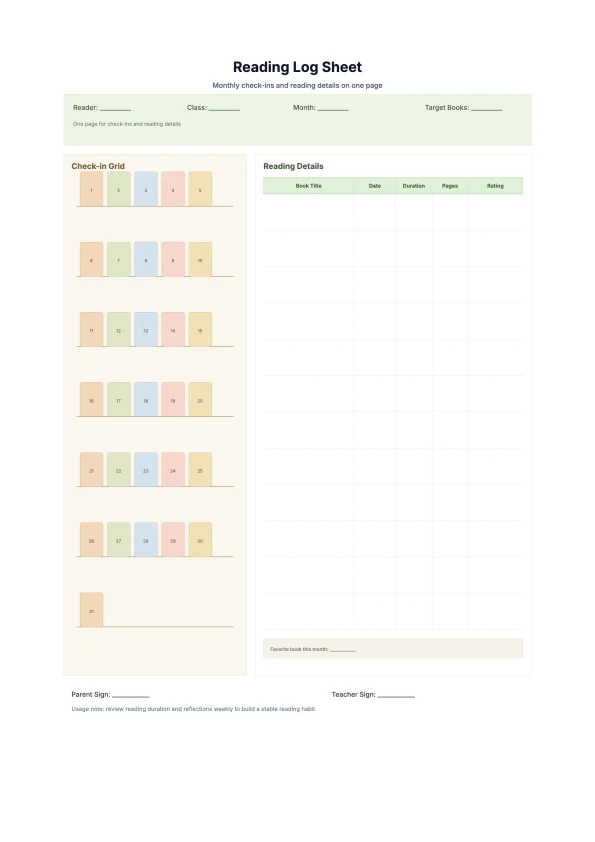
Print a free reading log sheet with monthly check-in and reading detail sections on one A4/Letter page.
PrintlyTool's reading log sheet combines a reading log with a dedicated reading challenge tracker area, so you can track both individual books and your progress toward an annual goal on the same page. This is especially useful for students and teachers managing classroom reading requirements — print one per student and track progress at a glance.
Reading Challenges: Turn a Solo Habit into a Motivating Game
Setting a yearly reading goal — "I will read 24 books this year" — is the most common approach. But number-of-books goals have a built-in problem: they incentivize shorter books and punish slower, denser reads. Here are alternative challenge formats that encourage better reading, not just more reading:
The Genre Bingo Challenge
Create a 5×5 grid with different categories: "a book in translation," "a memoir by someone unlike you," "a book published the year you were born," "a graphic novel," "a science book for non-scientists." The goal is not volume — it is breadth. By the end of the year, you have read 25 books that collectively expanded your perspective in ways a single-genre binge never could.
The Page-Count Challenge
Instead of "52 books," aim for "15,000 pages." This removes the bias against long books and rewards depth. War and Peace and three short essay collections can coexist peacefully in the same goal.
The Re-Read Challenge
How many books have you read exactly once, loved, and never returned to? Commit to re-reading one book per month. You will be surprised by what you notice the second time — and by how much you have changed since the first read.
The "Read What You Own" Challenge
Most readers have a shelf (or Kindle library) of unread books they have already purchased. Set a challenge to read 10, 20, or all of them before buying anything new. Your wallet and your TBR pile will both thank you.
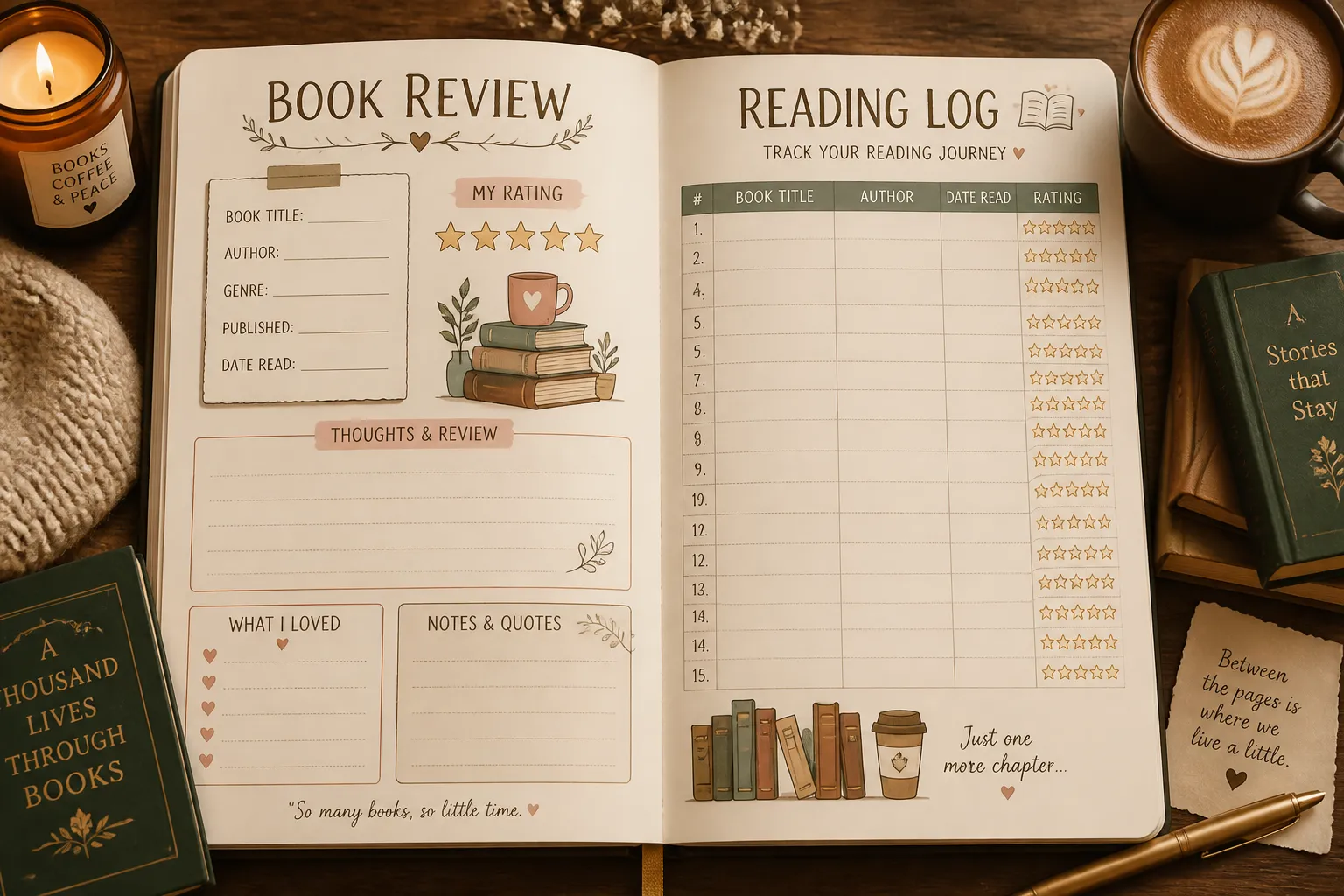
Track any of these challenges in your reading log — PrintlyTool's customizable template lets you add columns for challenge categories, page counts, or re-read markers.
How to Build a Reading Journal Habit
The best journal is the one you actually use. Here is how to make it stick:
- Keep the journal with your current book: If you read in bed, keep the journal on your nightstand. If you read on the couch, keep it on the coffee table. Friction is the enemy of habit — the journal must be within arm's reach when you finish a chapter.
- Write immediately after finishing: Do not wait until the next day. The emotions and thoughts are freshest in the 15 minutes after you close a book. Even 5 minutes of journaling captures more than a detailed entry written from fuzzy memory a week later.
- Accept imperfect entries: Some books deserve two pages of reflection. Others deserve three bullet points and a rating. Both are valid. A journal with a mix of deep and shallow entries is infinitely better than a blank journal you were too perfectionist to start.
- Review monthly: At the end of each month, flip through your entries. Circle the best book you read. Note a quote that stayed with you. This monthly review turns journaling from a chore into a reward — you get to revisit the highlights.
- Share selectively: You do not need to post every review online. But sharing one thoughtful review per month with a friend or book club keeps you accountable and deepens the social dimension of reading.
For students using reading journals as part of their study routine, pair it with our efficient learning methods guide for note-taking strategies that complement your reading practice. If you are new to PrintlyTool, check the getting started guide to learn how to customize and export any template.
How PrintlyTool's Reading Journal Is Different
Most printable reading journal PDFs come as fixed, pre-designed pages — one layout for everyone, regardless of what kind of reader you are. PrintlyTool's approach:
- Customize your rating system: Stars, numbers, emoji, letter grades, or your own labels — design the scale that makes sense to you
- Adjust sections to your reading style: Fiction readers need more space for characters and plot. Nonfiction readers need more space for key ideas and action items. Customize accordingly
- Choose your format: Single-page per book for light journaling, or multi-page spreads for deep dives
- Add or remove fields: Track translator, original language, book club discussion date, or any other dimension that matters to you
- No account required: Design, print, and start writing. No signup, no mailing list, no spam
FAQ: Reading Journals and Book Logs
What is the difference between a reading journal and a reading log?
A reading log is a simple list: title, author, date finished, maybe a rating. One line per book. A reading journal goes deeper: full-page entries with quotes, reflections, themes, and personal responses. Use the log for quick tracking and the journal for books you want to remember in detail.
How many books should I aim to read in a year?
There is no universal number. The average American reads 12 books per year. Avid readers often target 24-52 (2-4 per month). The right goal is one that stretches you slightly without making reading feel like a chore. If you read 6 books last year, aim for 12. If you read 40, aim for 52. The number matters less than whether you are reading consistently and enjoying it.
Should I journal about books I did not finish?
Yes — and note why you stopped. Was the writing style not for you? Did the book feel like it was repeating itself? Did you lose interest because life got busy and the book could not hold your attention? These observations sharpen your ability to choose better books in the future. A DNF (did not finish) entry is not a failure; it is data.
Can kids use a reading journal?
Absolutely. A simplified reading journal with space for title, author, a drawing of a favorite scene, and a "I liked this book because..." section is perfect for young readers. PrintlyTool's template is customizable enough to simplify for kids while keeping the same core structure. It builds the habit of active reading from an early age.
How do I organize multiple years of reading journals?
Use a binder with yearly dividers, or keep each year's journal in a separate notebook. At the end of each year, create a "Year in Reading" summary page: total books read, top 5, favorite quote of the year, a reading goal for next year. Over time, these summary pages become the most treasured part of your reading archive.
Is a printable journal better than a bound reading journal notebook?
Both work. A printable journal gives you unlimited fresh pages and full customization. A bound notebook feels more permanent and special. Many readers do both: use a printable journal for detailed reviews and a bound notebook as a reading log and quote collection. PrintlyTool's templates are designed to complement either approach.
What if I mostly listen to audiobooks?
Audiobooks absolutely count. Track the format in your journal — you may notice interesting patterns, like preferring fiction in audio and nonfiction in print. For audiobooks, pay extra attention to the narrator's name and your thoughts on the performance, since narration quality significantly shapes the experience.
Start Your Reading Journal Today
The books you read change you in small, cumulative ways. A reading journal makes those changes visible. It turns the private act of reading into a conversation with your future self — a record not just of what you read, but of who you were when you read it.
PrintlyTool's reading journal and reading log are free, customizable, and ready to print. Choose your format, set up your first entry, and start building a record of your reading life that you will treasure for years.