Free Printable Health Tracking Logs: Blood Pressure, Blood Sugar & Medication Records Made Simple
Your doctor asks how your blood pressure has been lately. You say "fine, I think." But "I think" is not a number, and your doctor needs numbers to make decisions about your care. Whether you are managing hypertension, tracking blood sugar, monitoring a chronic condition, or helping an aging parent stay on top of their health, a printable health tracking log is the simplest, most reliable tool available — and it does not require a smartphone, an app subscription, or the ability to navigate a small screen with arthritic fingers.
This guide covers PrintlyTool's four free customizable health tracking templates: a blood pressure log, a blood glucose tracker, a medication administration record, and a symptom tracker. Each one can be customized online — larger text, specific columns, your preferred layout — then exported as a PDF and printed. No email required. No app to download. Just the tools you need to bring better data to your next doctor's appointment.
Why Paper Health Logs Beat Apps for Many People
Health tracking apps are everywhere. Apple Health, MyFitnessPal, dedicated blood pressure and glucose apps — there are hundreds. So why would anyone choose paper in 2026?
The answer is not nostalgia. It is practicality:
- Zero learning curve: Open the notebook, pick up a pen, write down today's reading. No account creation, no notification settings, no software updates. For older adults who did not grow up with smartphones, this difference is everything.
- Larger, clearer text: PrintlyTool's health logs let you customize text size before printing. For someone with vision challenges, a 16pt font on paper is far more accessible than a 10pt font on a phone screen.
- Physical presence as a reminder: A blood pressure log taped to the bathroom mirror is seen every morning. An app notification can be swiped away in half a second and forgotten. The sheet of paper is patient; it waits.
- Doctor-ready without unlocking a phone: At an appointment, you hand the log to your doctor. They can scan weeks of readings in seconds, spot trends, and make treatment decisions. No scrolling through app screens, no "let me find that screen" moments.
- No battery, no Wi-Fi, no software obsolescence: A paper log never runs out of charge mid-reading. It never gets discontinued when a startup shuts down. It works exactly the same way in 2036 as it did in 2026.
For caregivers managing health records for an elderly parent, check out our caregiver daily record templates and handoff log strategies. Many of the same principles apply — clarity, accessibility, and immediate usability by anyone who walks in the door.
Blood Pressure Log: Track What Matters for Heart Health
Blood pressure is called the "silent killer" for a reason — hypertension often has no symptoms until a serious event occurs. Regular monitoring creates an early warning system that no single doctor's visit can provide, since readings taken in a clinical setting are often elevated by anxiety ("white coat hypertension").
What a Useful Blood Pressure Log Includes
PrintlyTool's blood pressure log is designed to capture the data your doctor actually needs:
- Date and time of each reading: Blood pressure fluctuates throughout the day. Tracking the time reveals patterns — does yours spike in the morning? Drop after exercise?
- Systolic and diastolic readings: The top and bottom numbers. Both matter for diagnosis and medication adjustment.
- Heart rate (pulse): Often recorded alongside blood pressure. Changes in resting heart rate can signal medication side effects or cardiovascular changes.
- Notes section: Record whether you took your medication before the reading, if you had caffeine recently, or if you were feeling stressed. Context makes the numbers meaningful.
How to Take Accurate Readings at Home
The accuracy of your log depends entirely on how you measure. Follow these steps every time:
- Sit quietly for 5 minutes before taking a reading. Do not measure immediately after walking, climbing stairs, or having an emotional conversation.
- Feet flat on the floor, back supported, arm at heart level. Crossing your legs or letting your arm dangle can raise your reading by 5-10 points.
- Use the same arm each time, and note which arm you use on the log. There is often a small but consistent difference between arms.
- Take 2 readings, 1 minute apart, and record both. The average is more reliable than a single measurement.
- Measure at consistent times — for example, 8 AM before breakfast and 8 PM before bed. Comparing "Wednesday morning after coffee" to "Friday evening after a workout" is meaningless.
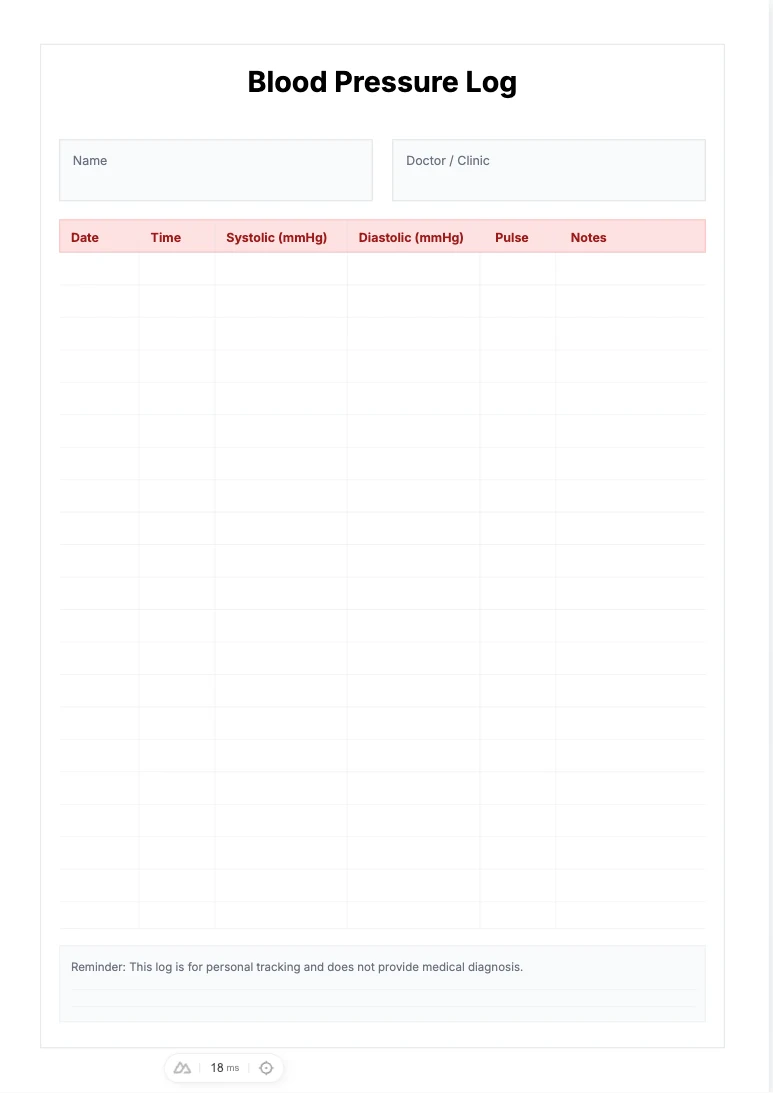
Free printable blood pressure log with date, time, systolic, diastolic, pulse, and notes fields.
Print your blood pressure log, post it near where you take your readings, and fill it in immediately after measuring. Do not rely on memory — even 5 minutes later, you might not remember whether the diastolic was 82 or 88.
Blood Glucose Log: Make Every Reading Count
For people with diabetes or prediabetes, blood sugar tracking is not optional — it is the primary feedback loop that guides food choices, medication dosing, and activity levels. A well-designed log turns dozens of isolated numbers into a story about how your body responds to different foods, exercise, and stress.
Beyond the Number: Context Is Everything
A single blood glucose reading of 140 mg/dL means very different things depending on context. Was it taken before breakfast (fasting) — in which case it may indicate a problem? Or 90 minutes after a meal — in which case it may be perfectly normal? Without context, numbers lose their diagnostic value.
PrintlyTool's blood glucose log captures:
- Fasting readings (before breakfast): The baseline that doctors use to evaluate overall glucose control
- Pre-meal readings: Shows your starting point before food
- Post-meal readings (1-2 hours after eating): Shows how your body handled the meal
- Bedtime readings: Helps prevent nighttime hypoglycemia
- Medication/insulin tracking: Links doses to glucose levels to identify if adjustments are needed
- Food and activity notes: Connect readings to specific meals or exercise sessions
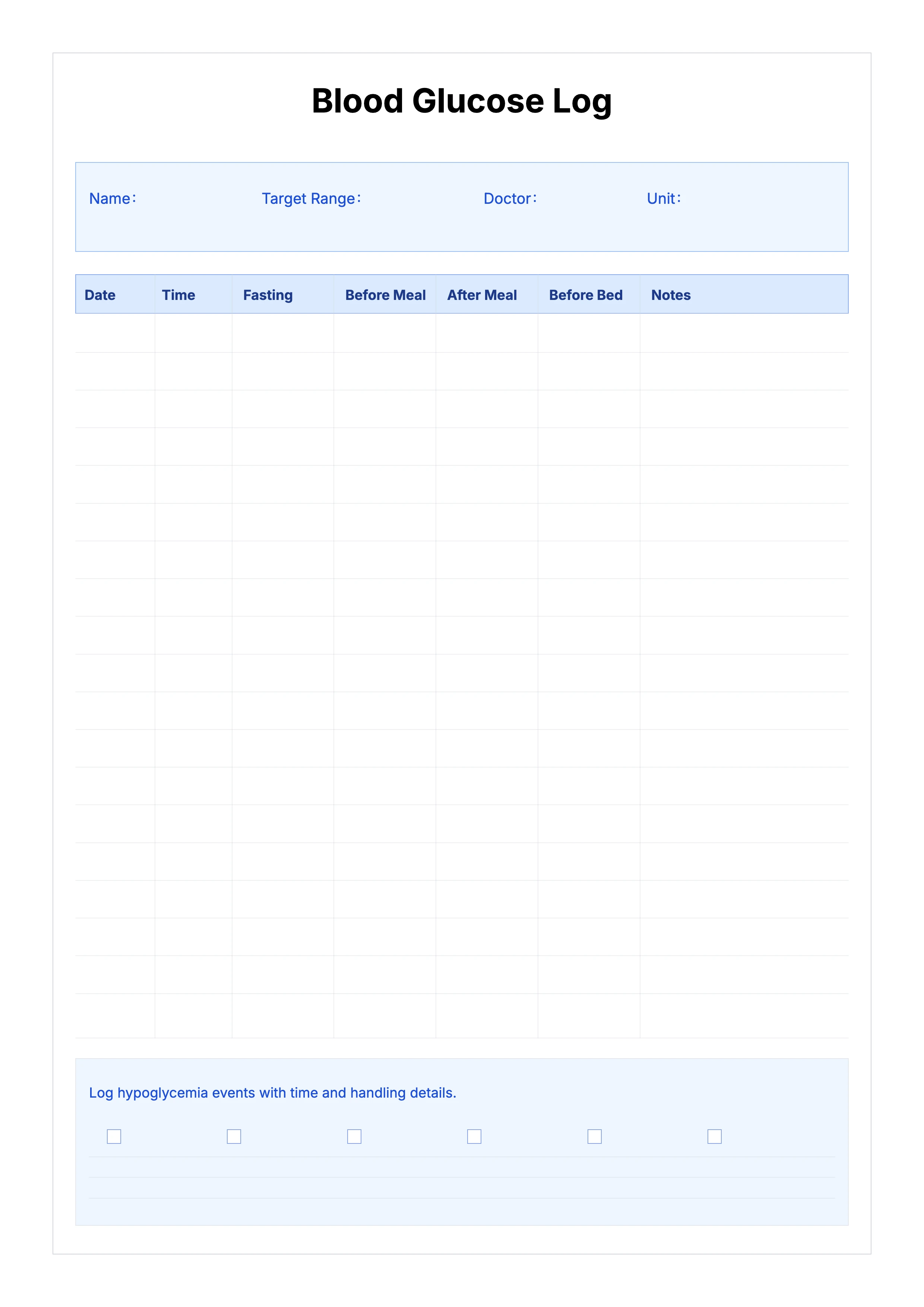
Free printable blood glucose log for fasting, pre-meal, post-meal, and bedtime readings with notes.
Bring a month of well-documented glucose logs to your endocrinologist appointment, and the conversation shifts from "how have you been feeling?" to "I can see the pattern — let's adjust your lunchtime insulin ratio."
Medication Log: Never Miss a Dose, Never Double Up
Medication errors happen most often not because people are careless, but because daily life is complex. You take a pill at 8 AM. By 10 AM, you cannot remember if you actually took it or just thought about taking it. Do you risk missing a dose, or risk doubling up? Both are dangerous.
When a Medication Log Is Essential
- You take 3 or more medications daily and tracking each one mentally is unrealistic
- You are on a tapering schedule (gradually increasing or decreasing a dose over weeks)
- Someone else — a caregiver, home health aide, or family member — administers some or all of your medications
- You take medications that are dangerous to miss or double (blood thinners, insulin, heart medications, anti-seizure drugs)
- You are preparing for a doctor's appointment and need to show exactly what you have been taking
What PrintlyTool's Medication Log Covers
The medication log template includes:
- Medication name and dosage per administration
- Frequency and specific times (not just "twice daily" but "8 AM and 8 PM")
- Checkboxes for each dose — check immediately after taking to prevent ambiguity
- Notes for side effects, missed doses, or reasons for deviation
- Date range spanning a full month on one printed page
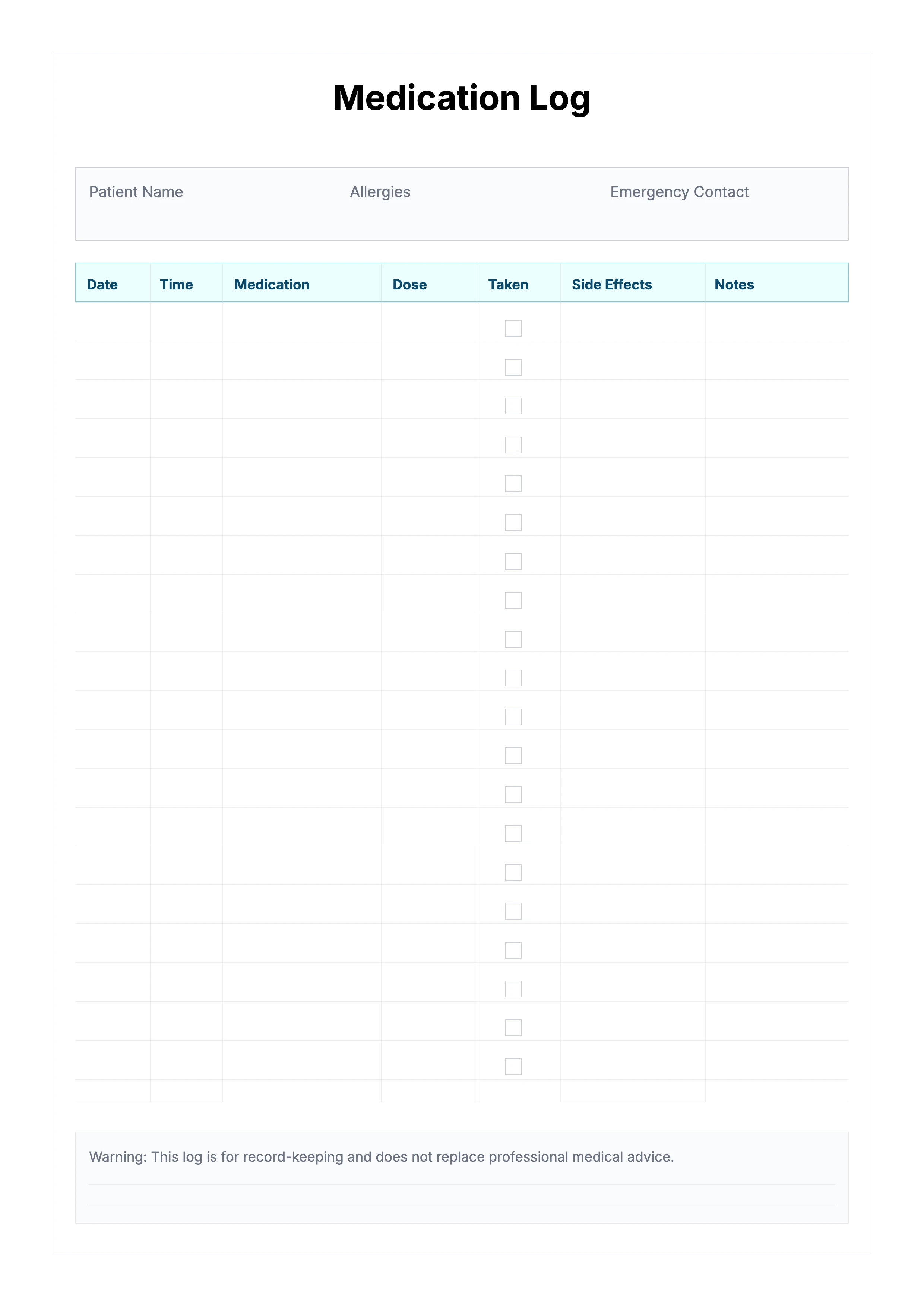
Free printable medication log with date, time, medication, dose, taken checkbox, side effects, and notes.
For caregivers managing medications across multiple people or pets, combining the medication log with a symptom tracker creates a complete health diary. If you also care for pets, our pet medication log guide shows how to adapt the same principles to animal care.
Symptom Tracker: Connect the Dots Between How You Feel and What You Do
Chronic conditions often involve fluctuating symptoms that are hard to summarize from memory. Was your pain worse this week than last? Did the new medication reduce your headaches, or did they stay the same? Without a record, you are guessing — and your doctor is guessing with you.
What to Track
| Symptom Detail | Why It Matters |
|---|---|
| Severity (1-10) | Subjective but essential. Your "6" might be different from someone else's "6," but your own trend over time is what matters. |
| Duration | A headache that lasts 30 minutes is different from one that lasts 6 hours. Duration changes can signal whether a treatment is working. |
| Triggers | What happened before the symptom? Ate a specific food? Exercised? Experienced stress? Patterns emerge over weeks of data. |
| Relief methods | What helped? Medication, rest, stretching, hot/cold therapy? This guides future treatment. |
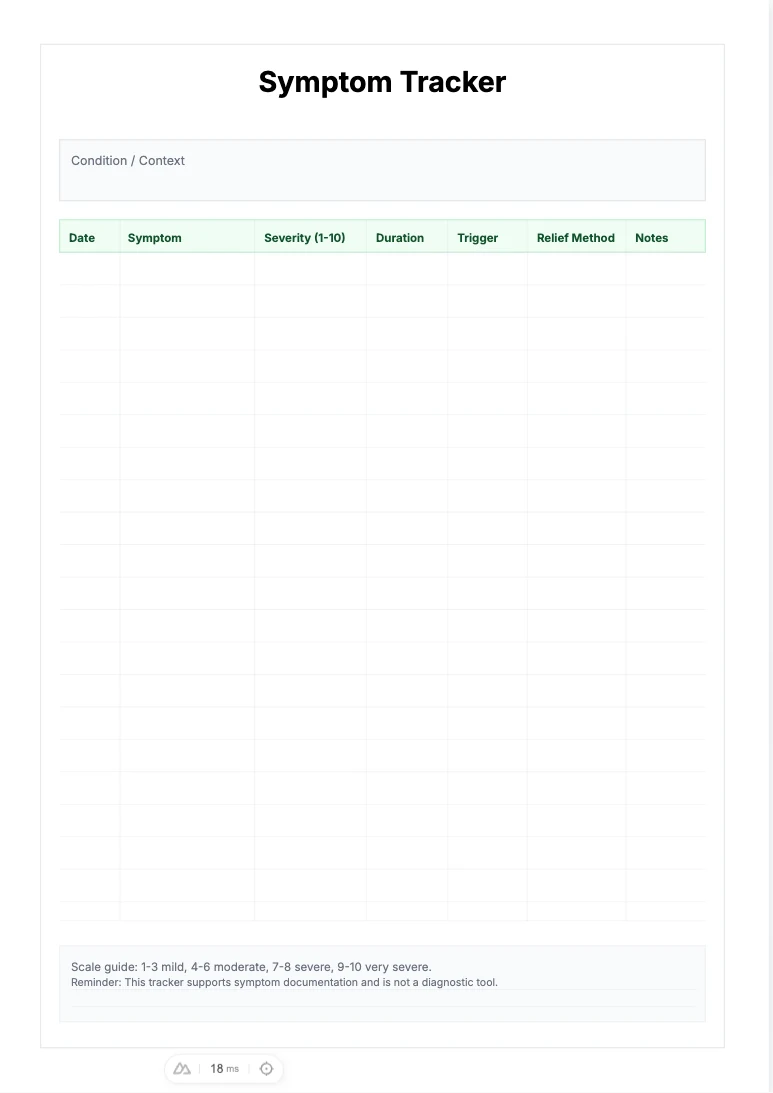
Free printable symptom tracker for recording symptoms, severity, duration, triggers, and relief methods.
Over time, a symptom tracker reveals connections you would never notice otherwise: "Every Tuesday afternoon I get a migraine — and every Tuesday I skip lunch because of back-to-back meetings." That insight alone can change your health.
How to Build a Complete Health Tracking System
Each of these four logs works on its own. Together, they form a comprehensive health diary:
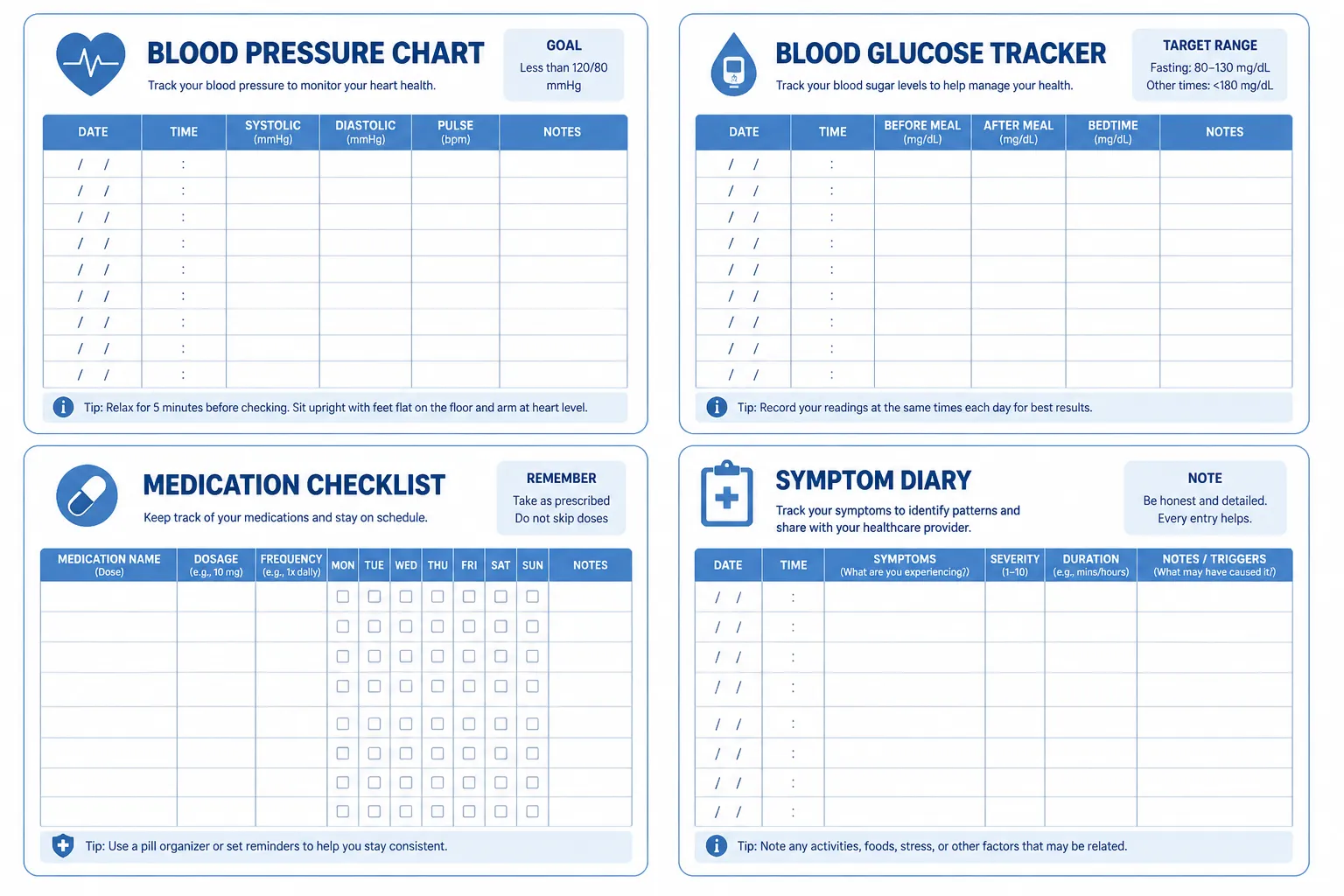
- Blood pressure log — morning and evening readings, kept in the bathroom or bedside table
- Blood glucose log — tied to meals, kept in the kitchen or dining area
- Medication log — checked off after each dose, kept near medications
- Symptom tracker — filled in as symptoms occur, kept in a central location
Once a month, gather all four logs and review them together. Look for patterns. Does your blood pressure spike on days you record high stress in the symptom tracker? Does your glucose dip on days you note "skipped lunch" on the medication log? These connections are the difference between managing a condition and truly understanding it.
Bring the full set to your next doctor's appointment. Most physicians say they rarely see this level of organized self-tracking from patients — and it changes the quality of care they can provide.
FAQ: Printable Health Tracking Logs
How often should I measure my blood pressure at home?
For most people managing hypertension, twice daily — once in the morning before medication and once in the evening — provides the best data. Take readings at the same times each day and record both. If you are just starting to monitor, measuring daily for two weeks gives your doctor a solid baseline.
What blood sugar levels should I aim for?
Target ranges vary by individual and should be set with your doctor. General guidelines: fasting (before breakfast) should be 80-130 mg/dL, and 1-2 hours after meals should be below 180 mg/dL. These are reference ranges, not medical advice — your targets may differ based on age, other conditions, and treatment goals.
Can I share my printed health logs with my doctor digitally?
Yes. After filling in your printed log, you can scan or photograph it and upload to your patient portal, or bring the physical copy to your appointment. Many doctors prefer paper logs because they can scan a full month of data in seconds — faster than navigating an app screen.
How do I make the text larger on a printable health log?
PrintlyTool's health logs are customizable before printing. Adjust text size, column width, and layout directly in the browser. This is especially useful for older adults or anyone with vision challenges who needs larger print than standard templates provide.
What is the best way to organize multiple health logs?
Use a three-ring binder with tabbed dividers — one section per log type. At the end of each month, move completed sheets to an archive section in the back. This keeps current logs accessible and historical data organized for trend review. Some people color-code: red for blood pressure, blue for glucose, green for medications.
Does PrintlyTool require an account to download health logs?
No. All templates are free, customizable online, and downloadable as PDF without any registration, email signup, or account creation. Print as many copies as you need, whenever you need them.
Can I use these logs for more than one person?
Absolutely. Print separate copies for each family member and label them clearly. If you are tracking health data for both yourself and an aging parent, use different colors of paper or highlighters to make each person's logs immediately distinguishable.
Start Tracking Today
Health data is only useful when it is recorded and reviewed. A blank log sheet is a missed opportunity to catch a trend early, adjust a medication before a crisis, or walk into a doctor's appointment with real answers instead of "I think I'm fine."
Choose the log that fits your current need, customize it for readability, print it, and start filling it in today. Your future self — and your doctor — will thank you.