Free Printable Guitar Tab Paper: Blank Tablature Sheets for Songwriting, Transcription & Practice
You come up with a riff. It sounds great. You play it three times to lock it in. The next day, you sit down with your guitar and — gone. That riff evaporated overnight because you did not write it down. Every guitarist knows this feeling. Blank guitar tab paper is the simplest, fastest way to capture musical ideas before they disappear — no software, no boot-up time, just a pencil and a sheet of tab that is ready the moment inspiration strikes.
This guide covers PrintlyTool's free customizable guitar tablature template: how to use blank tab paper effectively, when to pair tabs with standard notation, and why customizable tab sheets beat both pre-printed tab books and complex notation software for everyday practice.
Why Blank Tab Paper Still Matters in the Digital Age
Guitar Pro, MuseScore, Notion, Sibelius — there are powerful apps for writing guitar music. But every working guitarist still keeps blank tab paper nearby, and here is why:
- Speed: Opening a computer, launching software, and clicking notes onto a staff takes time. Grabbing a pencil and a sheet of tab paper takes two seconds. When inspiration is fleeting, two seconds versus two minutes is the difference between capturing an idea and losing it.
- No input friction: Tab software requires you to think like the software — select note durations, choose the right string, navigate menus. Blank paper lets you think like a musician. Scribble, cross out, draw arrows, write "try capo on 3rd fret here" in the margin. There is no "correct" way to use paper.
- Focus without distraction: A sheet of paper has no notifications, no software updates, and no temptation to check email. If you struggle to stay focused during practice or songwriting sessions, the analog approach removes digital distractions entirely.
- Works anywhere: Back porch, park bench, campfire, bus — anywhere you bring a guitar and a notepad. No battery required.
- Tangible progress: A notebook filled with your own tablature is a physical record of your musical development. Flip back six months and see how much better your ideas have become.
For guitar teachers, pairing tab paper with standard notation staff paper gives students the best of both worlds. Check out PrintlyTool's music paper template for standard notation alongside tab.
Guitar Tablature Basics: Reading and Writing Tab
If you are new to writing tab, here is the quick-start:
How Tab Lines Work
Guitar tab uses six horizontal lines, each representing a string:
e |-------------------|  (1st string — highest pitch, thinnest)
B |-------------------|  (2nd string)
G |-------------------|  (3rd string)
D |-------------------|  (4th string)
A |-------------------|  (5th string)
E |-------------------|  (6th string — lowest pitch, thickest)
Numbers on the lines tell you which fret to press. 0 means open string (no fret). 3 on the low E string means press the third fret on the thickest string.
Writing Chords in Tab
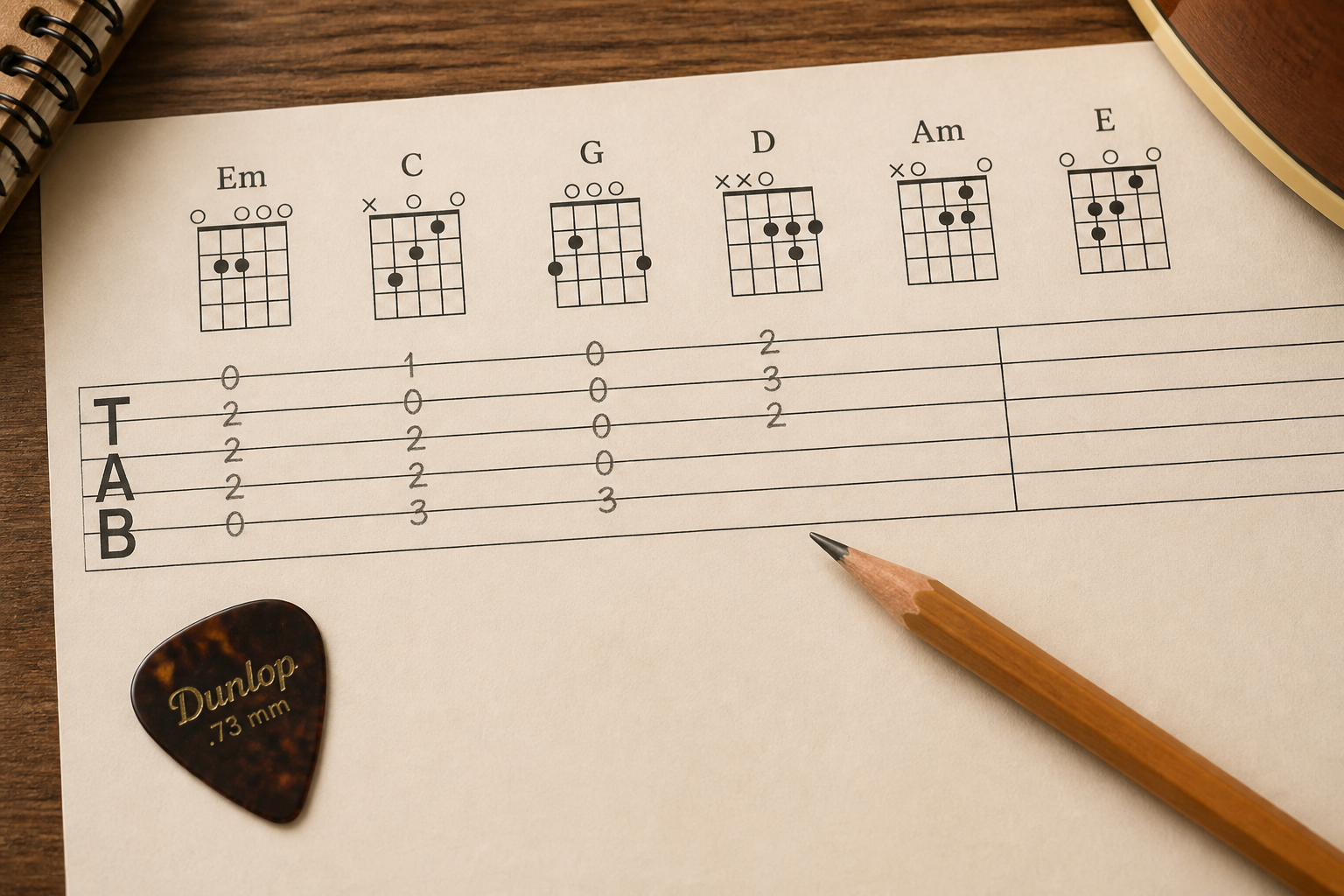
Chords are written as stacked numbers:
e |---0---|  (open)
B |---1---|  (1st fret)
G |---0---|  (open)
D |---2---|  (2nd fret)
A |---3---|  (3rd fret)
E |-------|  (not played)
That is a C major chord. The vertical alignment shows which notes ring together.
Common Tab Symbols
| Symbol | Meaning |
|---|---|
h | Hammer-on (e.g., 5h7) |
p | Pull-off (e.g., 7p5) |
/ or \ | Slide up or down (e.g., 5/7) |
b | Bend (e.g., 7b9 — bend at 7th fret to sound like 9th) |
r | Release bend |
~ or v | Vibrato |
x | Muted note / dead note |
( ) | Ghost note / optional note |
What Makes a Good Tab Sheet Design
Not all blank tab paper is created equal. The design of the sheet directly affects how usable it is, especially during focused practice or songwriting sessions:
Stave Spacing
Lines that are too close together make writing cramped and hard to read later. Lines too far apart waste space. PrintlyTool's tab template lets you adjust the spacing between staves to match your handwriting size and the complexity of what you are writing — wider spacing for notating bends, slides, and technique markings above the tab; tighter spacing for straightforward chord charts.
Measure Lines
Tab sheets with clearly marked measure boundaries help you stay organized. PrintlyTool includes light vertical measure dividers that keep your notation rhythmically structured without being visually intrusive. You can adjust how many measures appear per line.
Chord Diagram Boxes
Writing out tab for a song is one thing. Remembering the chord voicings is another. PrintlyTool's guitar tablature template includes customizable chord diagram boxes above the tab staves — blank chord grids where you draw in finger positions for each chord used in the piece.
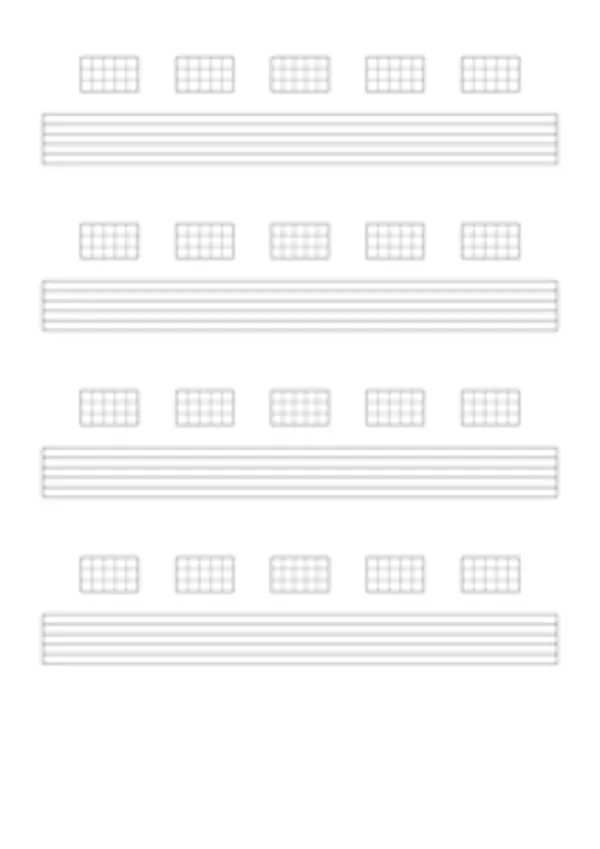
Professional guitar tablature template including chord diagrams and staff lines. Supports custom chord counts and line spacing, perfect for guitar practice and composition.
This chord-box-plus-tab layout is the standard format used in guitar magazines, method books, and professional transcriptions. It keeps everything you need — the chord shapes and the tablature — on a single page with no flipping back and forth.
When to Pair Tab with Standard Notation
Standard notation (the five-line staff with notes) communicates rhythm, dynamics, and phrasing far more precisely than tab alone. Tab tells you where to put your fingers; notation tells you when and how to play the notes.
PrintlyTool's music paper template gives you standard five-line staves that you can print alongside your tab sheets. Use this combination when:
- You are transcribing a solo and need to capture exact rhythms (triplets, syncopation, rests) that tab alone cannot communicate clearly
- You are writing music for other musicians — a saxophone player cannot read tab, but they can read notation
- You are studying music theory and want to see the relationship between notes on the staff and positions on the fretboard
- You are preparing for an exam or audition that requires notation literacy
Many guitarists start with tab-only sheets and gradually introduce standard notation as their reading skills develop. PrintlyTool supports both approaches — print tab sheets, staff paper, or both side by side.
Free music staff paper template with customizable staff line spacing, system spacing, and titles. Suitable for music composition, theory study, and transcribing.
How to Use Tab Paper in Your Practice Routine
A stack of blank tab sheets is useful. A system for using them is transformative. Here is how to integrate tab paper into different practice scenarios:
For Songwriting
Keep a dedicated songwriting notebook. Every time you stumble onto a riff, chord progression, or melody worth keeping, write it down immediately — even if it is just four bars. Date each entry. Review your notebook once a week; you will be amazed by how many forgotten ideas become full songs when given a second look.
For Transcription
Learning songs by ear is one of the most effective ways to improve as a guitarist. Put on a recording, slow it down if needed, and write out the parts in tab. The act of transcribing forces you to listen actively — you hear details (ghost notes, subtle bends, pick dynamics) that you would miss if you just played along with a YouTube tutorial. A month of regular transcription will improve your ear more than a year of passive practice.
For Guitar Lessons
If you teach guitar, blank tab sheets are essential. Write out exercises, scale patterns, and song sections for your students during the lesson. They leave with a custom practice sheet tailored to exactly what they need to work on — far more effective than pointing them to page 47 of a method book. The chord diagram boxes on PrintlyTool's template are especially useful here: draw the chord shapes for a new song, write the tab for the strumming pattern below, and your student has a complete reference.
For Band Rehearsal
When you are working out song arrangements with a band, tab paper is the fastest way to communicate guitar parts. Write out the riff, make copies for the bassist and keyboardist (who can read tab even if they play different instruments), and everyone is on the same page — literally.
How PrintlyTool's Tab Paper Is Different
Most "free printable guitar tab" websites offer one fixed PDF — one layout, one spacing, one design. PrintlyTool's approach is different because every guitarist's needs are different:
- Adjustable stave spacing: Wider for detailed transcriptions with technique markings, tighter for simple chord charts or scale exercises
- Customizable chord diagram boxes: Choose how many chord grids appear per page, or remove them entirely if you only need tab lines
- A4 and US Letter sizes: Print correctly regardless of where you live — no more trimming or scaling issues
- Clean, professional lines: Even spacing, consistent ink density, no pixelation — the sheets look like they came from a music store, not a home printer glitch
- No email registration: Design your tab paper and download the PDF. No signup, no mailing list, no spam
- Re-print anytime: Ran out of sheets before a lesson? Spilled coffee on your transcription? Open the page and print again in seconds
For beginners just starting their guitar journey, pair the tab paper with our getting started guide to set up your full practice toolkit.
FAQ: Guitar Tablature Paper
What is the difference between guitar tab and standard notation?
Guitar tab uses six lines representing the six strings, with numbers showing which fret to play. It tells you where to place your fingers. Standard notation uses a five-line staff and note symbols to show pitch and rhythm. Tab is easier to learn and read, especially for beginners. Standard notation communicates rhythm and dynamics more precisely. Many guitarists use both.
Can I use guitar tab paper for bass guitar?
Yes. A standard six-string tab sheet works perfectly for four-string bass — just use the bottom four lines (E, A, D, G) and ignore the top two, or fold the paper to visually separate the four bass strings. For extended-range basses (5-string, 6-string), the full six-line tab is already correct.
What paper size should I use for tab sheets?
US Letter (8.5×11 inches) is standard in North America. A4 (210×297mm) is standard in most other countries. PrintlyTool's tab template supports both formats — select your region's paper size before printing so the sheets fit perfectly without scaling.
How many tab staves should fit on one page?
For detailed transcriptions with bends, slides, and written technique notes, 6-8 staves per page gives enough space to write clearly. For simple chord charts or scale exercises, 10-12 staves per page is efficient. PrintlyTool lets you adjust stave spacing to find your ideal density.
Is blank tab paper better than tab software?
Neither is objectively better — they serve different purposes. Tab paper is faster, more portable, and better for capturing spontaneous ideas. Tab software (Guitar Pro, MuseScore) is better for creating polished, shareable transcriptions with playback. Most experienced guitarists use both: paper for the creative stage, software for the final clean version.
Can I print tab sheets with chord diagrams already filled in?
PrintlyTool's chord diagram boxes are blank, designed for you to fill in the specific chord voicings for your piece. For common open chords and barre chord shapes, print a separate chord chart reference sheet and keep it alongside your blank tab paper.
How do I keep my tab sheets organized?
A three-ring binder with tabbed dividers is the simplest system. Create sections for: original songs, transcriptions, exercises and scales, and lesson materials. Date every sheet. Once a binder fills up, label the spine with the date range and start a new one. Over time, these binders become an archive of your entire musical development.
Start Writing Your Music Today
The best guitarists do not wait for inspiration — they capture it. Blank tab paper is the net that catches musical ideas before they slip away. Whether you are writing your first song, transcribing a solo by ear, or preparing lesson materials for students, having clean, customizable tab sheets within arm's reach makes the difference between "I had this great idea once" and "here is what I wrote."
PrintlyTool's guitar tablature template is free, customizable, and ready whenever you are. Design your layout, print a stack, and keep it next to your guitar.