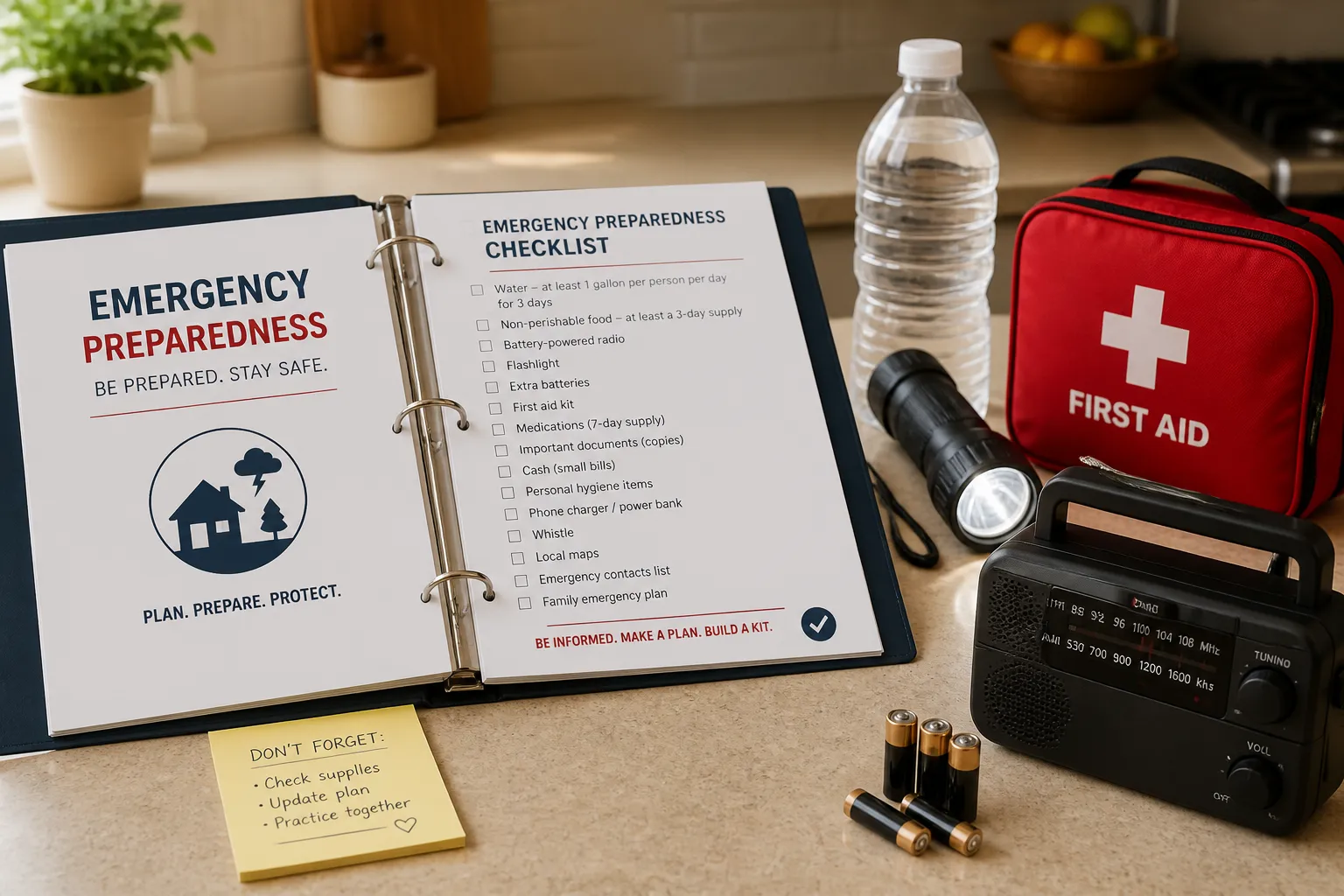
Free Printable Emergency Preparedness Binder for Families
It is 2 a.m. A weather alert wakes you up: a wildfire is approaching your neighborhood, and you have 15 minutes to evacuate. Or a hurricane is forecast to make landfall in 48 hours. Or an earthquake just knocked out power and water for what could be days.
In any of these moments, the question is not whether you have a plan. The question is whether your plan is written down, printed, and sitting in a binder that you can grab with one hand while carrying a child with the other. A printable emergency preparedness binder turns abstract worry into actionable readiness — it is the single document that tells every family member what to do, where to go, and what to bring when minutes matter.
This guide covers what FEMA and the Red Cross recommend every family have in an emergency binder, the essential documents and checklists to include, and how PrintlyTool's free customizable emergency kit checklist helps you build a complete preparedness system in about 30 minutes. No app download. No reliance on cell service. Just a printed binder that works when nothing else does.
Why a Printed Emergency Binder Beats a Digital Plan Every Time
Smartphones and cloud storage are great — until the cell tower is down, the battery is dead, or your device was left behind in the rush to evacuate. Emergency responders and disaster preparedness agencies consistently recommend paper backups for the same reasons:
- Zero dependency on infrastructure: A printed binder needs no power, no signal, no internet. When the grid is down — and it will be in a major disaster — your phone is a dark rectangle. Your binder is fully functional.
- Accessible to anyone: If you are injured or separated from your family, a neighbor, first responder, or older child can open the binder and immediately see emergency contacts, medical information, and evacuation routes. A locked phone is useless to anyone but you.
- No cognitive load under stress: During an evacuation, your brain's decision-making capacity narrows sharply — this is a well-documented physiological response to acute stress. A printed checklist eliminates decisions. You follow the list. You move. You do not stand in the hallway trying to remember what to pack.
- Grab-and-go speed: A three-ring binder on a designated shelf in a known location takes one second to grab. Finding the right app, navigating to the right screen, and scrolling through a document while your hands are shaking is not a plan — it is a delay that could matter.
FEMA's official guidance on family emergency planning emphasizes that every household should maintain a physical emergency kit and written plan, updated at least annually. The Red Cross Emergency app is a useful supplement, but both organizations are clear: the paper plan is the primary plan.
What Goes in an Emergency Preparedness Binder
A complete binder contains four categories of documents. Print each section on a different color of paper if possible — it makes finding the right page faster under pressure.
Section 1: Emergency Contacts and Medical Information
| Document | Why It Matters |
|---|---|
| Family emergency contact card | Out-of-area contact (someone unaffected by the local disaster), local emergency numbers, school and workplace contacts. Every family member carries one; the binder holds the master copy. |
| Medical information sheet | Each family member's blood type, allergies, medications with dosages, chronic conditions, and primary care physician contact. First responders need this information instantly if someone is unconscious. |
| Insurance policy summaries | Policy numbers, claim-filing phone numbers, and agent contact info for health, home/renters, auto, and life insurance. Do not store the full policies — just the summary page with the numbers you need to start a claim. |
| Pet and service animal info | Veterinarian contact, vaccination records, microchip numbers, and a current photo. Many emergency shelters require proof of vaccination to admit pets. |
Section 2: Evacuation Plan and Maps
- Primary and secondary evacuation routes from your home, printed from Google Maps or a physical road map. Do not assume GPS will work during a disaster — satellite signals can be disrupted and cell networks overloaded.
- Meeting points: One location near your home (mailbox, neighbor's driveway) and one location outside your neighborhood (a relative's house, a specific store parking lot) in case family members are separated when evacuation begins.
- Local shelter locations with addresses and directions. Your county emergency management office publishes these annually — print the current list and update it each year.
- School and daycare emergency protocols: How each child's school handles early dismissal, lockdown, or evacuation, including where they will relocate children if the school site is compromised.
Section 3: Emergency Kit Inventory Checklist
This is the core supply list. FEMA recommends maintaining a kit with at least three days of supplies for each family member. Use PrintlyTool's customizable checklist to track what you have, what you need, and expiration dates:
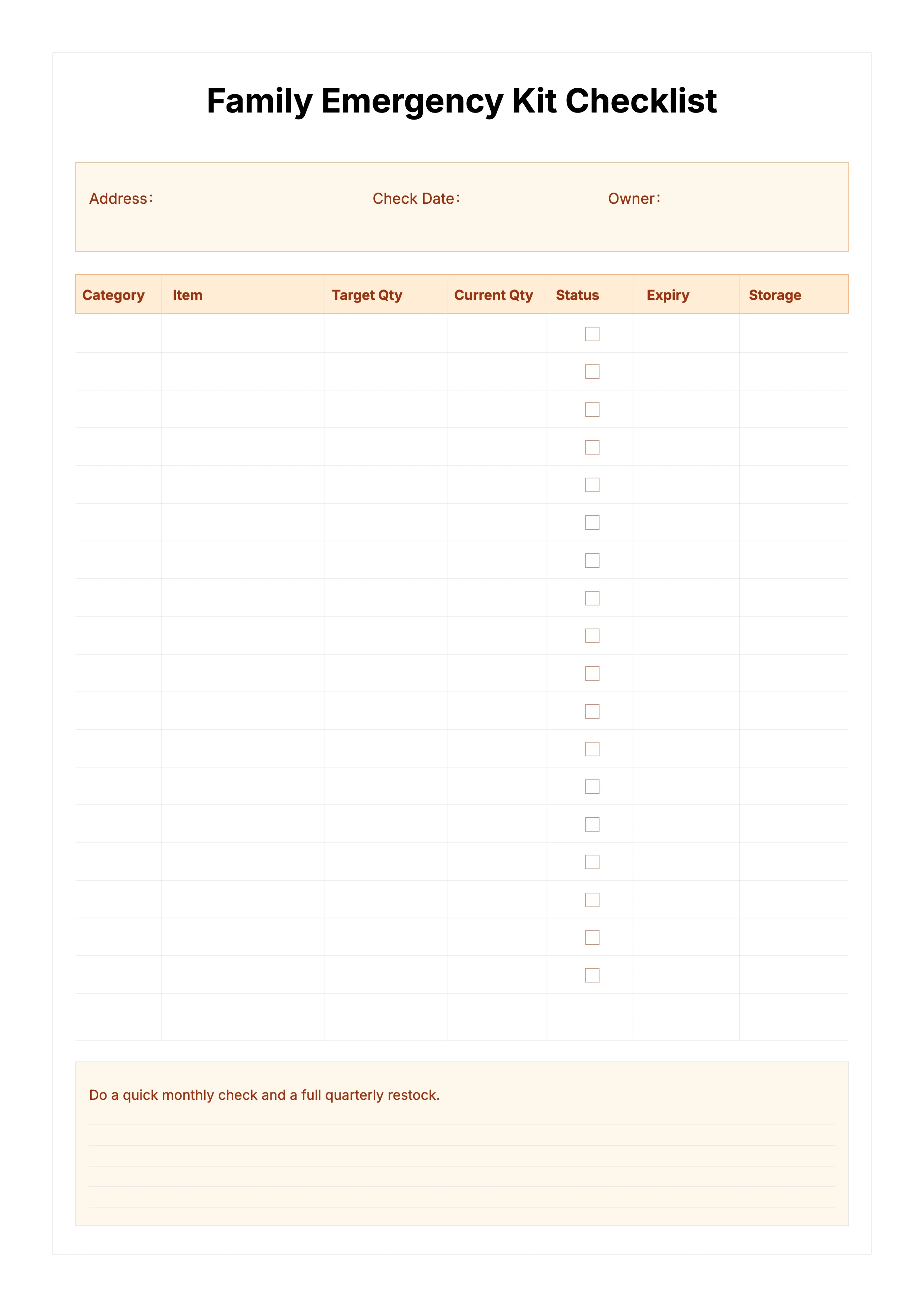
Free printable family emergency kit checklist with item category, target quantity, current quantity, expiry date, and storage location.
- Water: One gallon per person per day, minimum three-day supply. For a family of four, that is 12 gallons. Store in food-grade containers and replace every six months.
- Non-perishable food: Three-day supply per person. Canned goods (with a manual can opener), protein bars, dried fruit, nuts, and ready-to-eat meals that require no cooking.
- First aid kit: Bandages, antiseptic wipes, gauze, medical tape, scissors, tweezers, pain relievers, anti-diarrhea medication, and any prescription medications in a waterproof container.
- Flashlights and batteries: At least two flashlights with spare batteries. Avoid candles — open flames are a fire risk in damaged buildings with potential gas leaks.
- Multi-tool or wrench: For turning off utilities. Know where your gas shutoff valve, water main, and electrical panel are located, and attach the correct tool to the valve with a zip tie so it is always there.
- Personal hygiene items: Toothbrushes, toothpaste, soap, hand sanitizer, menstrual products, diapers and wipes if applicable, garbage bags, and zip-top bags.
- Blankets and warm clothing: At least one blanket or sleeping bag per person. Include rain gear and sturdy shoes — you may need to walk through debris.
- Cash: ATMs and card readers will not work during a power outage. Keep at least $200 in small bills in the binder or kit.
- Copies of critical documents: Birth certificates, passports, marriage licenses, property deeds, and vehicle titles — stored in a waterproof pouch inside the binder. Originals should be in a safety deposit box.
For a complete system, pair this checklist with a home inventory for insurance — documenting your belongings before a disaster makes insurance claims dramatically faster and more complete.
Section 4: Communication Plan
During a disaster, local phone lines are often jammed, but long-distance lines may still work. Every family member should know:
- The out-of-area contact person — a relative or friend who lives in a different state. All family members call or text this person to report their status. This single point of contact resolves the "I do not know where anyone is" panic.
- A script for what to say: "This is name. I am at location. I am safe / I need help with specific issue. I will check in again at time." Practice this script with children so they can deliver it clearly even when scared.
- Text, do not call: Text messages use far less bandwidth than voice calls and are more likely to get through on overloaded networks. Teach everyone to send a text first and reserve voice calls for emergencies.
How to Use PrintlyTool's Emergency Kit Checklist
The template gives you a structured inventory table organized by category. Customize it to match your family's specific needs:
- Set the title: Name it something clear like "Smith Family Emergency Kit — 2026" so it is immediately identifiable.
- Customize the categories: The default template covers food, water, first aid, tools, hygiene, and documents. You can add categories specific to your situation: baby supplies, pet supplies, medical equipment, or cold-weather gear.
- Add expiration tracking: For food, water, medications, and batteries, add a date column and check it every six months. Set a recurring phone reminder for the same dates you change your smoke detector batteries.
- Print multiple copies: Keep one in the binder, one with the emergency kit itself, and give one to your out-of-area contact. If your home is destroyed, someone else has a copy of your plan.
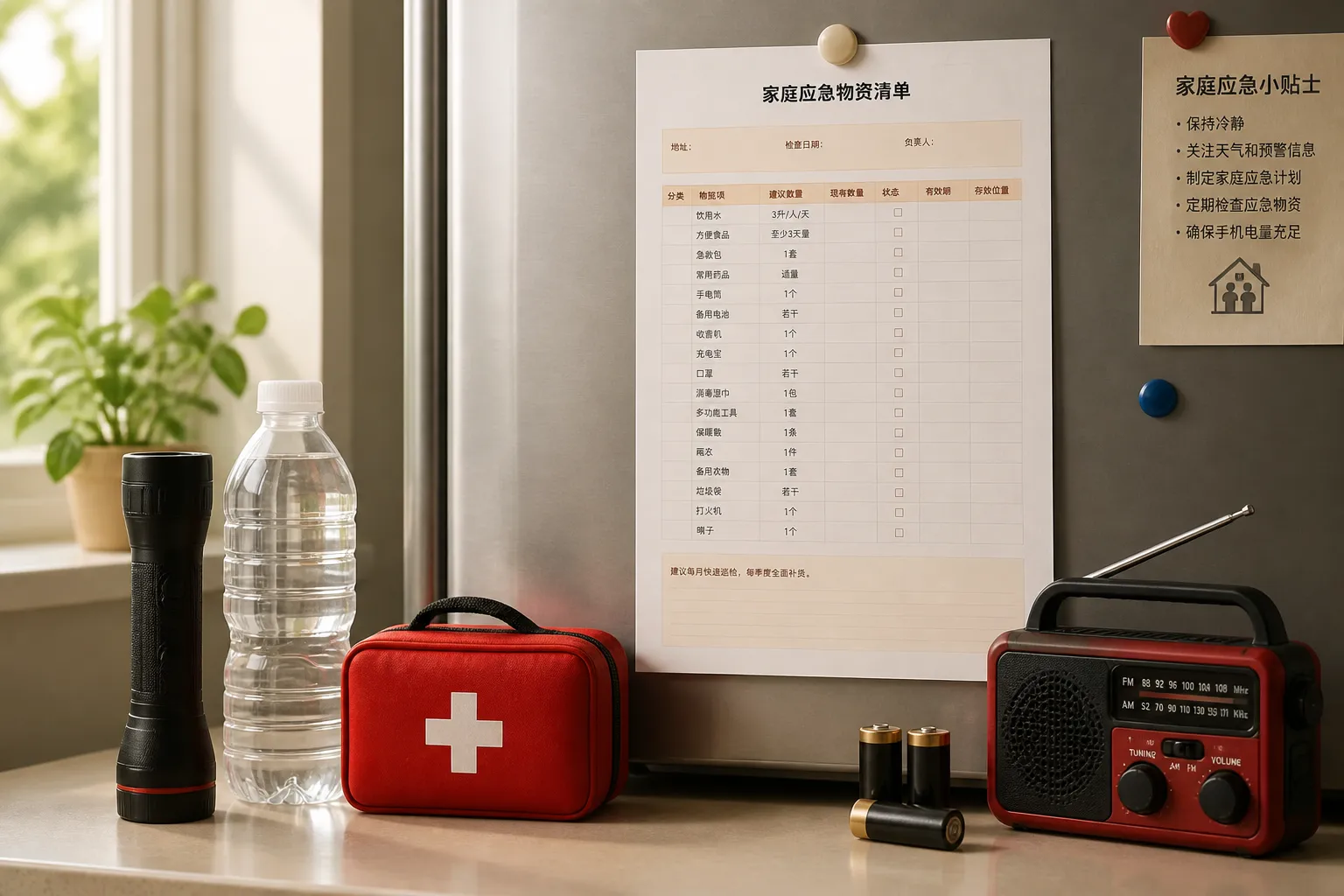
For the contact information side of preparedness, the printable contact form template lets you create clean emergency contact cards that every family member can carry in a wallet or backpack.
Seasonal Preparedness: What Changes by Season and Region
Emergency preparedness is not one-size-fits-all. Your binder should be updated seasonally to reflect the most likely threats in your region and time of year.
Hurricane Season (June–November, Atlantic and Gulf Coast)
- Pre-position supplies by August 1 so you are not competing with panicked crowds at hardware stores 48 hours before landfall
- Add plywood and mounting hardware for windows, or pre-measured hurricane shutters
- Include a battery-powered or hand-crank weather radio — this is your only information source when power and cell service are gone
- Store important documents in waterproof, floating containers inside the binder
Wildfire Season (May–November, Western US)
- Pre-pack a "go bag" for each family member with 48 hours of essentials — if you receive an evacuation order, you should be out the door in under 10 minutes
- Include N95 masks for smoke protection — wildfire smoke inhalation causes more hospitalizations than burns in many fire events
- Keep vehicle fuel tanks at least half full during high-risk periods so you can evacuate without stopping
- Digitally scan irreplaceable photos and documents and store copies with your out-of-area contact — the binder holds the inventory list; the scans live off-site
Earthquake Preparedness (Year-round, West Coast and Seismic Zones)
- Secure heavy furniture and water heaters to wall studs — most earthquake injuries come from falling objects, not collapsing buildings
- Store emergency supplies in multiple locations: one kit in the home, one in each vehicle, and one at work — you do not know where you will be when the shaking starts
- Practice "Drop, Cover, and Hold On" with children quarterly — muscle memory works when conscious thought freezes
- Know how to shut off gas, water, and electricity. Attach the correct wrench to the gas meter with a zip tie
Winter Storms and Power Outages (November–March, Northern US and Midwest)
- Add cold-weather gear to the emergency kit: hand warmers, extra blankets, insulated sleeping bags, and a safe indoor heating method (never use outdoor grills or generators indoors due to carbon monoxide risk)
- Keep a snow shovel and ice melt accessible — not buried behind summer equipment in the garage
- Stock extra prescription medications — a three-day supply becomes a problem if roads are impassable for a week
FAQ: Common Questions About Emergency Preparedness
How often should I update my emergency binder?
FEMA recommends reviewing your emergency plan and kit every six months. A practical schedule: check food, water, and medication expiration dates when daylight saving time changes in spring and fall — you are already changing clocks and smoke detector batteries, so it is easy to remember.
What is the single most overlooked emergency supply?
Prescription medications. Most people keep medications in a bathroom cabinet and do not think about them until they are needed. During an evacuation, grabbing pill bottles in the dark while panicked leads to missed medications. Keep a seven-day supply of each prescription in a labeled waterproof container inside the emergency kit, and rotate it every six months so nothing expires.
How much water do I really need to store?
One gallon per person per day, minimum three days — but if you live in a hot climate or have young children, nursing mothers, or family members with medical conditions, plan for one and a half gallons per person per day. This water is for drinking and basic hygiene only — it does not cover cooking, bathing, or flushing toilets. Store additional water for those purposes if you have space.
Should I keep my emergency binder in the house or the car?
In the house, in a designated, known location that every family member can reach quickly. A shelf near the most-used exit door is ideal. Do not store it in the garage (fire risk), attic (hard to reach quickly), or basement (flood risk). If you have a second vehicle that is always parked at home, you can keep a duplicate binder in the trunk as a backup.
What if I live in an apartment and have limited storage space?
Even a small apartment can accommodate a compact emergency kit. Use the space under the bed, the bottom of a closet, or a storage ottoman. Prioritize water, food, first aid, important documents, and a flashlight — those five categories cover the most critical needs. A single backpack or small duffel bag can hold three days of supplies for one person.
How do I prepare for a disaster if I have limited mobility or a disability?
Create a personal support network — at least three people (neighbors, nearby relatives, coworkers) who agree to check on you during an emergency. Give each of them a copy of your emergency plan and a key to your home. Register with your local emergency management office if they maintain a voluntary registry of residents who may need assistance during evacuations. Include mobility aids, spare batteries for powered devices, and backup charging methods in your kit.
Should I include my pets in the emergency plan?
Absolutely. Many people refuse to evacuate without their pets, which puts human lives at risk. Keep pet carriers accessible, not buried in storage. Maintain vaccination records and a current photo of each pet in the binder — many emergency shelters require these for admission. Pack a three-day supply of pet food, a collapsible water bowl, and any medications. For more detailed pet preparedness, see our pet care record guide.
The 30-Minute Rule: Start Your Binder This Week
Disasters do not schedule themselves around your convenience. Every week you put off building an emergency binder is a week you are betting nothing will happen — and that bet has no upside.
The solution is the same 30-minute rule that applies to home inventories: set aside half an hour this week. Print the emergency kit checklist. Fill in your family's contact information. Walk through the house and note what supplies you already have and what you need to buy. Even an incomplete binder is a massive improvement over nothing.
PrintlyTool's family emergency kit checklist is free, customizable, and works offline. You can set the categories, adjust the inventory columns, add expiration date tracking, and print a clean professional sheet in under two minutes. Combine it with our home inventory checklist and emergency contact form to build a complete emergency preparedness binder.
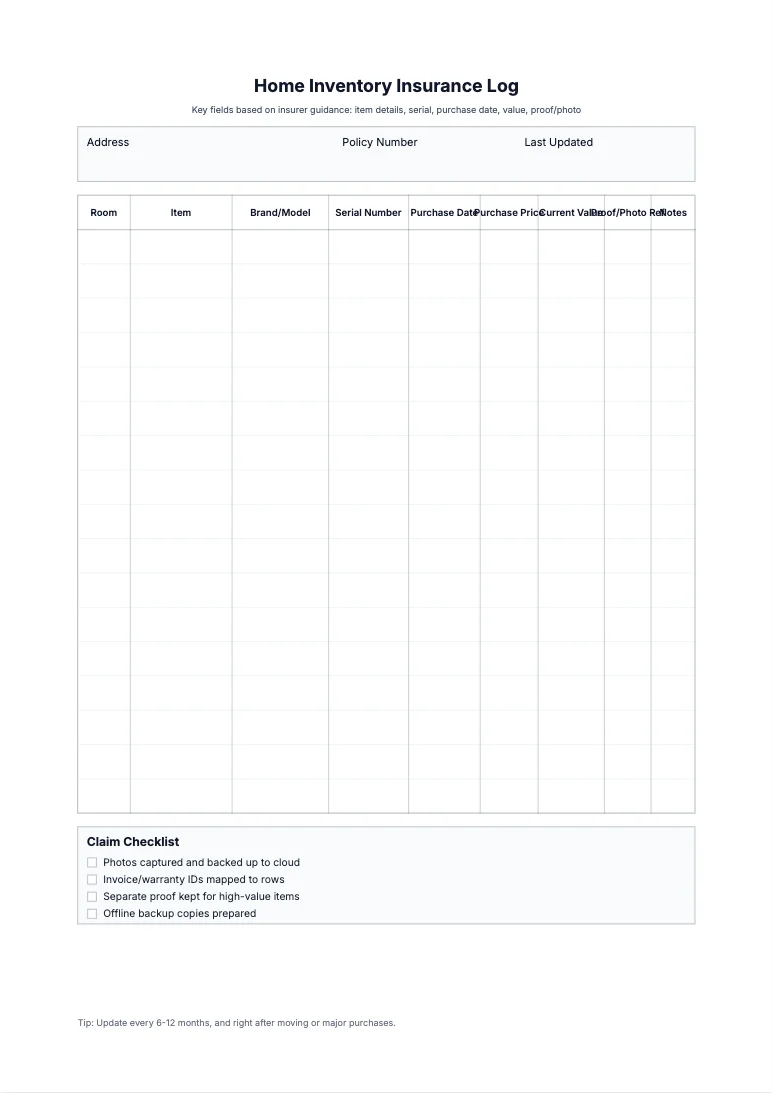
Free printable home inventory sheet for rooms, items, models, serial numbers, values, and proof references.
A printed binder on a shelf is the difference between controlled action and panicked scrambling. Build yours this week. Your family is counting on you to be ready.